Overview
The swift fox is a small, fast fox of Colorado’s eastern plains. After a steep decline across its range, it is now widespread again in Colorado’s shortgrass prairie, and CPW still lists it as a State Special Concern species.
CPW lists the swift fox as a State Special Concern species, yet it is also a legally harvested furbearer in Colorado.
The swift fox has never been federally listed. It was a federal candidate from 1995 to 2001. Today, Colorado Parks and Wildlife surveys find swift foxes on around 80% of surveyed shortgrass prairie, with no change detected in 15 years.
Natural History
Adult swift foxes weigh 2 to 3 kilograms (about 4.5 to 6.5 pounds). They stand about 30 centimeters (12 inches) tall and are about 80 centimeters (31 inches) long.
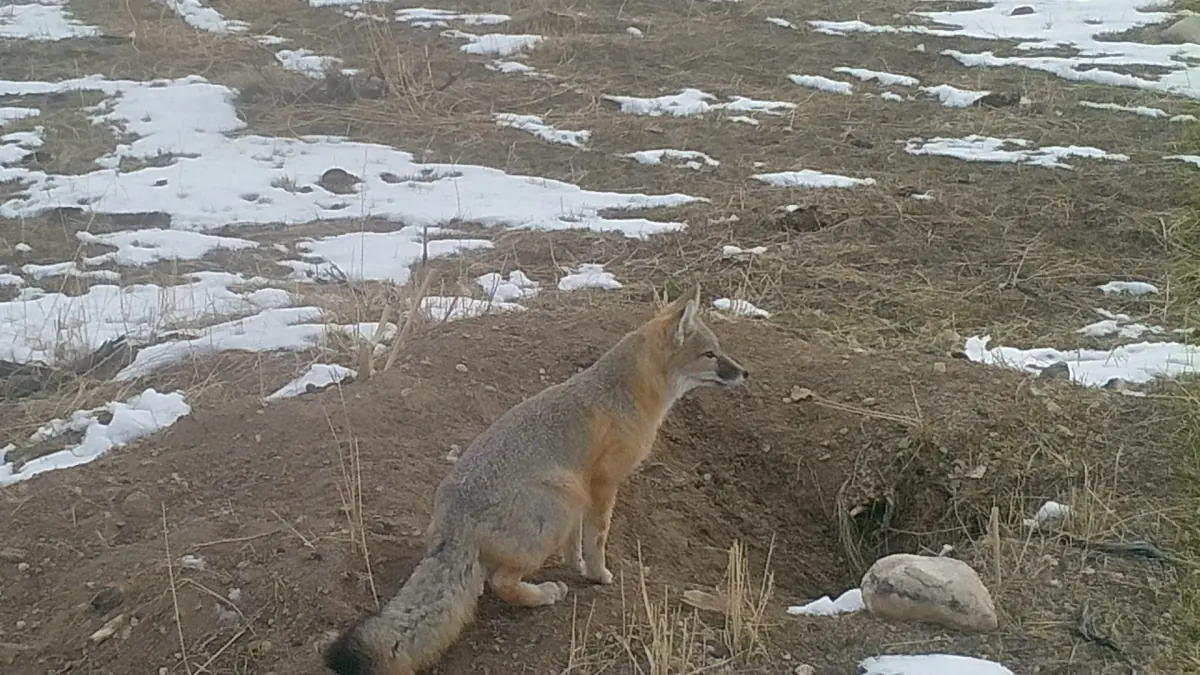
The fur is light gray to buff-tan, with black patches on the sides of the snout and a black tip on the tail. Swift foxes can reach up to 31 miles per hour.
They eat a wide variety of small mammals, birds, reptiles, insects, plants and carrion.
Swift foxes depend on dens year-round, to escape predators, shelter from weather and raise young. Den entrances are about 7 to 9 inches (17.5–22.5 cm) across. The foxes dig their own dens or use the burrows of other animals, including prairie dogs.
Swift foxes form monogamous pairs. In Colorado, breeding is generally from late December to early January. After about 50 days, litters of 3 to 6 pups are born in March or April.
Swift Fox or Kit Fox?
The swift fox and the kit fox look alike. The kit fox has larger ears, lives only on the Western Slope, and is state endangered. The swift fox lives on the eastern plains.
Habitat and Range
Swift foxes once ranged from central Alberta to central Texas, and from western Iowa and Minnesota to central Colorado.
In Colorado today, swift foxes occupy 22 of the 29 counties in their historical range. That is about 102,566 square kilometers (about 39,600 square miles), or 95% of the state’s historical distribution.
CPW surveys shortgrass prairie every 5 years. Occupancy is around 80%, with no change detected in 15 years. Colorado Outdoors reported in 2023: “Between 80-85% of surveyed prairies in Colorado are considered to be occupied by swift foxes.”
Primary Threats
The historical decline
Swift foxes declined sharply from the early 1800s to the mid-1900s because of settlement, conversion of prairie, predator control and unregulated trapping.
Today
CPW lists road deaths and coyote predation as threats, partly because swift foxes often den near roads.
Recovery & Conservation
Federal reviews
The U.S. Fish and Wildlife Service received a petition in 1992 to list the swift fox as endangered. On June 16, 1995, USFWS found listing “warranted but precluded,” which made the fox a candidate. On January 8, 2001, USFWS removed it from the candidate list, finding it was not likely to become endangered. By then, the fox was known to occupy about 40% of its historic range, in 9 of the 10 states where it once lived, including Colorado.
The Swift Fox Conservation Team
The team formed in 1994, joining ten state wildlife agencies across the fox’s range. Its work showed swift foxes were “more abundant, widely distributed, and more flexible in habitat requirements than originally thought.”
Rankings
NatureServe ranks the swift fox G3, vulnerable.
Harvest
Hunters with a furbearer license may take swift foxes in Colorado, and CPW estimates the harvest by survey; pelt tagging is not required. On private land, artificial light may be used at night to hunt “red, gray or swift foxes.”
Colorado foxes for Montana
CPW live-trapped 30 foxes near Lamar in 2021 and 18 from the Pawnee National Grassland in 2023 to help restore a population on the Fort Belknap Indian Reservation in Montana. The 2023 effort ended September 15.
What You Can Do
- Drive carefully on plains roads, especially at dusk and at night.
- Keep grasslands intact.
- Follow the rules. Hunters and trappers should follow CPW furbearer regulations.
- Report sightings to CPW.
- Explore related species. Read the kit fox and black-tailed prairie dog profiles.
Sources
- Colorado Parks and Wildlife, swift fox species page
- CPW, threatened and endangered wildlife list
- CPW, furbearers in the field
- WAFWA, swift fox conservation assessment (2024)
- Federal Register (1995), swift fox finding
- Federal Register (2001), annual notice of findings
- CPW, Swift Fox Conservation Team
- Natural Heritage New Mexico, swift fox
- Colorado Outdoors (2023), swift fox translocation project update