Overview
The burrowing owl is one of Colorado’s most distinctive and immediately recognizable birds — small, long-legged, and active during daylight hours, often seen standing upright at burrow entrances on the eastern plains, rotating its head with the alert, deliberate quality that makes owls so compelling to watch. Most owls are creatures of darkness and forest. This one lives underground on open grassland and hunts in full sun. It is genuinely different from every expectation an owl carries.
In Colorado it is state threatened, with no federal Endangered Species Act protection. Protection comes from state law and the federal Migratory Bird Treaty Act, not the Endangered Species Act — and neither triggers the consultation requirements that can influence development decisions on federally permitted projects. Its conservation depends on what Colorado chooses to do, and on whether the owners of eastern plains land decide that prairie dog colonies are worth keeping.
That last point is not incidental. The burrowing owl’s fate in Colorado is inseparable from the fate of the black-tailed prairie dog — and through that shared dependency, it is part of the same ecological story as the black-footed ferret.
Natural History
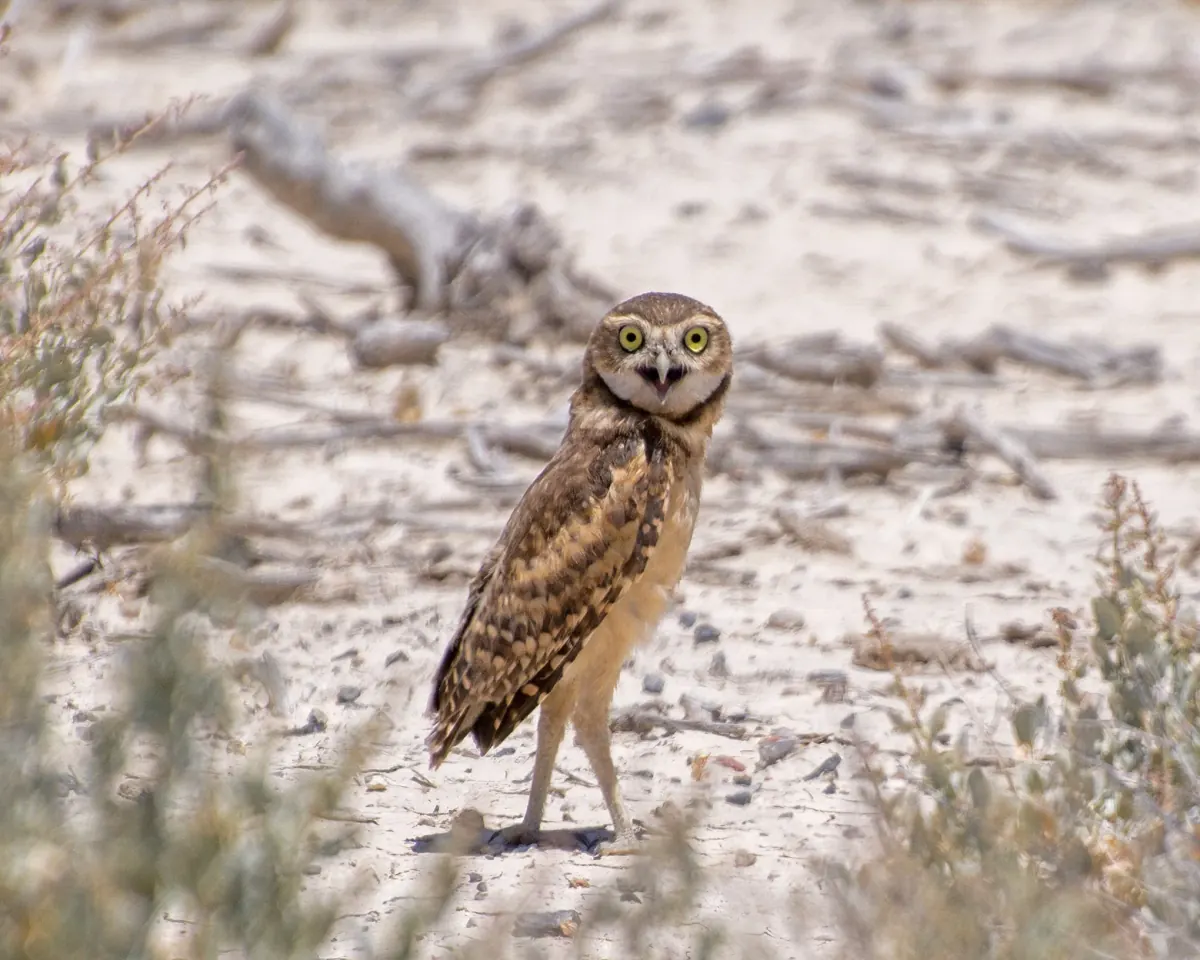
The burrowing owl (Athene cunicularia) is a small, compact owl standing 7.5 to 10 inches tall with a wingspan of 21 to 24 inches and a weight of 4.5 to 9 ounces. Unlike most owl species, males are slightly larger than females — a reversal of the usual raptor pattern. The plumage is brown with white and tan spots across the back and barring on the breast; white eyebrow markings above bright yellow eyes give the face an expressive, almost quizzical appearance. The legs are conspicuously long — an adaptation for a life spent running across open ground rather than gripping branches.
It is one of very few diurnal owls, active during daylight and hunting by sight across short vegetation. Prey includes grasshoppers, beetles, and other large insects, as well as rodents, lizards, and occasionally small birds. Adults are year-round opportunists — they will eat almost anything catchable at their scale.
Nesting is underground, almost always in abandoned black-tailed prairie dog burrows in eastern Colorado. In Colorado, burrowing owls do not dig their own burrows; they rely on burrows dug by prairie dogs, ground squirrels, and badgers. Adults line burrow entrances with dried animal dung — a behavior once dismissed as coincidental but now understood to serve two functions: it masks the scent of eggs and young from mammalian predators, and it attracts dung beetles as convenient prey.
Clutch size runs 6 to 12 eggs, incubated for 28 to 30 days, with young fledging in approximately six weeks. Fledglings remain in the parent territory through the summer. The species is migratory in Colorado, arriving March through May and departing August through October for wintering areas in Mexico and the southwestern United States. Adults in good condition may live 6 to 8 years.
The Prairie Dog Connection
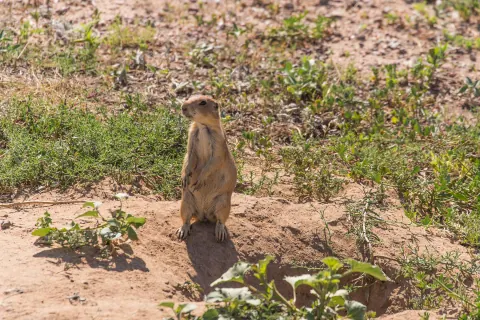
In eastern Colorado, burrowing owls nest almost exclusively on black-tailed prairie dog (Cynomys ludovicianus) colonies, and this relationship is not casual or substitutable. Prairie dog colonies provide the owl with everything it needs to breed successfully: a ready supply of excavated burrows sized appropriately for a small owl, reduced vegetation height that enables the low-flight hunting style the owl depends on, the constant predator alarm calls of hundreds of prairie dogs that extend the owl’s early-warning system across a much larger area than it could monitor alone, and the dilution effect of a dense colony that reduces any individual bird’s probability of predation.
Take the prairie dogs away and the owls leave. The relationship has been documented consistently enough across the range that burrowing owl presence is now used as a reliable proxy for prairie dog colony health.
That collapse reflects the loss of most of the black-tailed prairie dog’s historic occupied range. The causes are familiar: sylvatic plague introduced from Asia in the early 20th century, which moves through prairie dog colonies with lethal efficiency; conversion of native grassland to agriculture and development; and a century of active eradication programs that treated prairie dogs as competitors for cattle forage.
The burrowing owl’s decline maps directly onto that collapse. It is also what connects the burrowing owl directly to the black-footed ferret. Both species are closely tied to black-tailed prairie dog colonies. Both have experienced parallel, severe declines driven by the same forces. Both depend for recovery on a prairie dog ecosystem that the surrounding culture has spent a century trying to eliminate. The ferret’s story gets more attention — it is a charismatic mammal with a dramatic near-extinction narrative. But the burrowing owl’s story is the same story told from a different vantage point, and its absence from federal ESA protection makes it in some ways more vulnerable, not less.
Primary Threats
Prairie dog decline is the foundational threat — everything else is secondary to it. When sylvatic plague sweeps through a prairie dog colony, the owl nests on that colony disappear with it. Plague can eliminate a colony within weeks; without intervention in the form of oral vaccine bait distribution or colony treatment with insecticide dust, recovery of both prairie dogs and the owls that depended on them can take years.
Habitat loss and fragmentation through agricultural conversion and urban and suburban development has eliminated prairie dog colonies across the eastern plains. The Front Range has been particularly impacted — historically dense prairie dog country that now runs largely under subdivisions and commerce.
Active eradication continues on both private and public lands, though it has decreased from historic levels. Poisoning and shooting programs targeting prairie dogs remove the substrate on which burrowing owl colonies depend.
Vehicle collisions are a significant source of direct mortality along eastern plains roads, particularly during fall migration when young-of-year birds are dispersing and unfamiliar with road hazards.
Wind turbine collisions have emerged as a measurable threat as wind energy development expands across the eastern plains, in the same landscape that supports the owl’s breeding population.
Pesticide exposure affects owls both directly, through the uptake of rodenticides used for prairie dog control, and indirectly, through reduced insect prey availability in heavily treated agricultural areas.
Predation by feral cats and dogs contributes to adult and juvenile mortality in colonies near developed areas. Feral cat predation is particularly significant near the urban-rural interface on the Front Range.
Climate change adds compounding pressure through increased drought frequency, altered precipitation timing, and spring temperature extremes that can affect insect emergence timing, chick survival, and prey availability.
Because the owl is not ESA-listed, Section 7 consultation does not apply. Its nests, eggs, and adults are protected federally under the Migratory Bird Treaty Act and by Colorado’s state threatened status.
Recovery & Conservation
The burrowing owl is a Tier 2 Species of Greatest Conservation Need in Colorado’s 2025 State Wildlife Action Plan. USFWS lists the Western Burrowing Owl as a Bird of Conservation Concern in the regions covering Colorado. Neither designation carries the force of law.
Colorado Parks and Wildlife maintains recommended survey protocols. CPW survey guidelines call for repeated point counts during the breeding season at known and potential colony sites. A 2022–23 Colorado State University and CPW survey of eastern Colorado prairie dog colonies found owl occupancy similar to 2005 levels, though northern Colorado may be declining.
The most effective single conservation action for burrowing owls in Colorado is the conservation of black-tailed prairie dog colonies — their size, health, and connectivity. Research in eastern Colorado found that active prairie dog colonies, regardless of size, support higher owl occupancy and breeding success; when colonies went inactive, owls almost always disappeared.
Permanent land protection through conservation easements on properties supporting active prairie dog colonies provides the most durable form of habitat security.
What You Can Do
- Report sightings to iNaturalist and eBird. Breeding season records from eastern Colorado — particularly from specific prairie dog colonies — are genuinely useful data. Even fall and spring migration observations help document movement corridors.
- If you find prairie dog colonies with burrowing owls, report the location to CPW. Active nest sites that aren’t in the database can’t be managed or monitored.
- Respect nesting areas from late March through early August. CPW treats owls as potentially present March 15 through October 31, and its survey guidance calls for owl surveys before prairie dog control during that window. Approach burrow entrances slowly and at distance; sustained disturbance at active burrows can cause nest abandonment. If you see adult owls repeatedly alarm-calling or young owls retreating underground, you’re too close.
- Support conservation of black-tailed prairie dog colonies on both public and private lands. The political context for prairie dog conservation is contested on the eastern plains. Landowners who maintain or restore colonies are performing a real conservation function that deserves recognition.