Overview
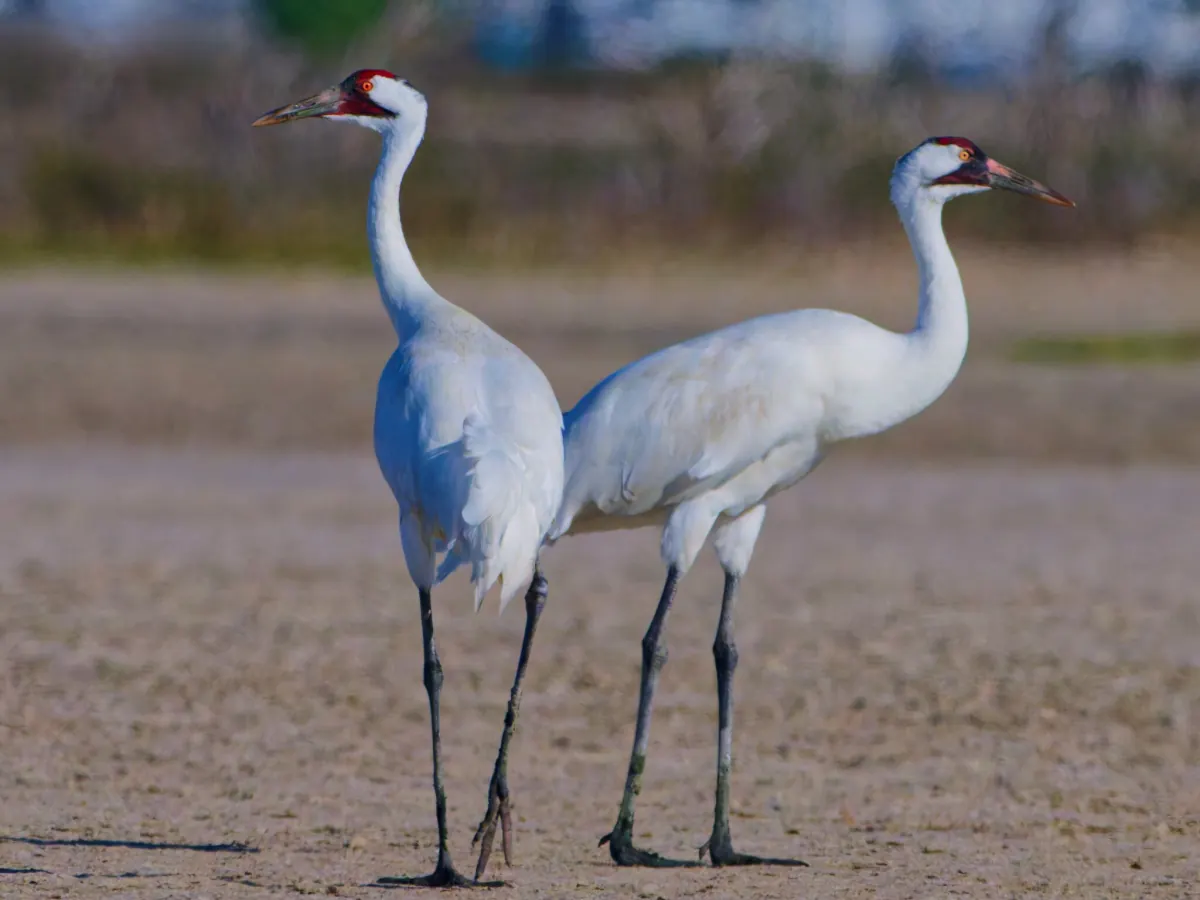
The whooping crane is the tallest bird in North America, standing nearly five feet with a wingspan reaching 7.5 feet. Its brilliant white plumage, red crown, and black facial markings are unmistakable at any distance. It is also, statistically speaking, one of the rarest large birds on earth — brought to within one bad breeding season of extinction by the middle of the 20th century, and still far from secure today.
In 1941, the migratory flock that winters in Texas numbered just 15 or 16 birds; with a small non-migratory flock in Louisiana, about 21 wild whooping cranes remained anywhere. Hunting and the systematic destruction of the wetland habitats the species depends on had reduced a bird that once ranged across the central continent to one migratory flock wintering on the Texas coast and a Louisiana remnant that soon disappeared.
The Aransas–Wood Buffalo flock was estimated at 540 birds in winter 2025–26, after a record 557 the winter before; counting reintroduced flocks, about 700 whooping cranes live in the wild. The recovery goal is 1,000 birds by 2035. The recovery is one of the genuine conservation success stories in North American wildlife management. It is also not a finished story. At current population size, a single catastrophic event — a disease outbreak, a severe hurricane at the Texas wintering grounds, a prolonged drought — could eliminate a substantial portion of the species in a single event.
Colorado’s part in that story is historical rather than current. The Aransas–Wood Buffalo population — the only self-sustaining wild flock, which breeds at Wood Buffalo National Park in Canada and winters at Aransas National Wildlife Refuge in Texas — migrates east of Colorado. Colorado’s real chapter was a bold experiment in the San Luis Valley that ultimately failed.
Natural History
The whooping crane (Grus americana) is a large, long-lived bird with a complex social structure. Adults form pair bonds that can last for life. They are highly faithful to migration routes and wintering grounds, returning to the same locations year after year. Young cranes accompany their parents for the first migration, learning the route directly — a behavioral transmission of knowledge that made the species profoundly vulnerable to disruption.
The breeding season begins at Wood Buffalo National Park in northwestern Canada, where pairs nest in remote boreal wetland complexes from May through August. Clutch size is typically two eggs, but most pairs raise only one chick to fledging — the first-hatched chick usually outcompetes the second. Migration south begins in October and November.
In winter, the birds concentrate at Aransas NWR on the Texas Gulf Coast, where blue crab and other wetland invertebrates provide the bulk of the diet. The narrow wintering range — essentially one location for the majority of the wild population — creates a severe concentration risk that has been a central concern of recovery planning.
Diet during migration includes agricultural grains, invertebrates, small vertebrates, and plant material in wetlands. The birds’ use of agricultural fields along the central flyway is a relatively modern behavioral adaptation that has helped sustain the population through the historical loss of native wetland stopover habitat.
Habitat in Colorado
Colorado sits west of the main migration corridor, which runs through Nebraska, Kansas, and Oklahoma. Whooping cranes are rare vagrants here; CPW reports no Colorado sightings since 2010. Colorado’s real chapter is the Rocky Mountain experiment: from 1975 to 1989, biologists placed whooping crane eggs in sandhill crane nests at Grays Lake, Idaho. The young cranes migrated with their foster parents, staging for weeks in the San Luis Valley before wintering at Bosque del Apache, New Mexico. The birds never paired, and the last one died in 2002. Monte Vista and Alamosa national wildlife refuges were designated critical habitat in 1978; that designation was removed in 1997.
Threats
Powerline collisions are a leading cause of documented mortality during migration. The transmission infrastructure crossing the central flyway creates collision hazards that are difficult to mitigate fully.
Habitat loss at stopover wetlands along the migration route reduces the quality and availability of feeding and resting habitat during the energetically demanding migration.
Shooting — illegal take — has historically been a source of mortality and remains a concern for a species with so few individuals.
Small population vulnerability means that any catastrophic event affecting a significant portion of the population at a single location — particularly the Texas wintering grounds — could cause disproportionate harm. Disease, severe weather, or oil spill at Aransas could eliminate a substantial fraction of the wild population in a single winter.
Climate change threatens to alter the hydrology of Wood Buffalo breeding habitat and the Texas coastal marsh wintering habitat, and may intensify the droughts that reduce wetland stopover habitat quality along the migration route.
Recovery & Conservation
Whooping crane recovery has been a multi-decade, multi-agency effort involving USFWS, the Canadian Wildlife Service, the International Crane Foundation, and numerous state and provincial agencies. Captive breeding, long centered at USGS Patuxent Wildlife Research Center until 2018, now continues at the International Crane Foundation and partner zoos, maintaining a captive population as insurance against catastrophic wild population loss.
An eastern migratory population was established in Wisconsin, partly by teaching young cranes to follow ultralight aircraft; that method ended in 2015. A non-migratory flock has been reintroduced in Louisiana since 2011.
Critical habitat was designated in 1978, including Monte Vista and Alamosa national wildlife refuges in Colorado’s San Luis Valley; that Colorado designation was removed in 1997, and no critical habitat remains in Colorado.
Recovery of the Aransas–Wood Buffalo population from 15 or 16 birds in 1941 to 540 in winter 2025–26 demonstrates that concerted, sustained conservation effort can make meaningful progress for highly endangered species. It also demonstrates how long and resource-intensive that progress requires.
What You Can Do
- If you see a whooping crane in Colorado, stay well back and report it to eBird and to the International Crane Foundation at https://savingcranes.org/report-a-whooping-crane-sighting/. Include location, number of birds, behavior, and a photograph if possible.
- Give any crane a wide berth. If you encounter cranes in a field or wetland, remain in your vehicle, do not approach on foot, and do not use calls or other stimuli that cause the birds to flush. An adult whooping crane forced to expend energy avoiding humans during migration pays a real cost.
- Support wetland conservation along the central flyway. Wetland complexes that provide safe, productive stopover habitat shorten the migration and reduce its energy cost for individual birds.