Status under active review. USFWS proposed in August 2024 to list the eastern subspecies (Argynnis idalia idalia) as endangered and the western subspecies (A. i. occidentalis, which includes Colorado) as threatened. As of September 2026, no final rule has been published. Check the USFWS species page for the current determination. Review quarterly.
Overview
The regal fritillary was once one of the most abundant and conspicuous butterflies on the American prairie. It was large, visually striking, and widespread across the tallgrass and mixed-grass prairie belt from the Atlantic coast to the Great Plains — a species that people actually noticed, because the male’s bright orange forewings and dark hindwings spangled with white and blue spots are remarkable by any standard.
It is now largely gone from the eastern third of its historical range. East of the Mississippi River, the regal fritillary has been extirpated from nearly every state where it once occurred. The western subspecies survives across 14 states, but Colorado is only sparsely occupied along its borders with Kansas and Nebraska, at densities far below what was documented historically.
Eastern Colorado is the southwestern edge of the species’ range. CPW notes that most Colorado sightings are late-season strays from Kansas and Nebraska, and the Colorado Natural Heritage Program knows of only one breeding population in the state. Colorado’s birds belong to the western subspecies (Argynnis idalia occidentalis), which USFWS proposed for listing as threatened in August 2024. As of September 2026, no final rule has been published. Colorado has no state listing for the species.
Natural History
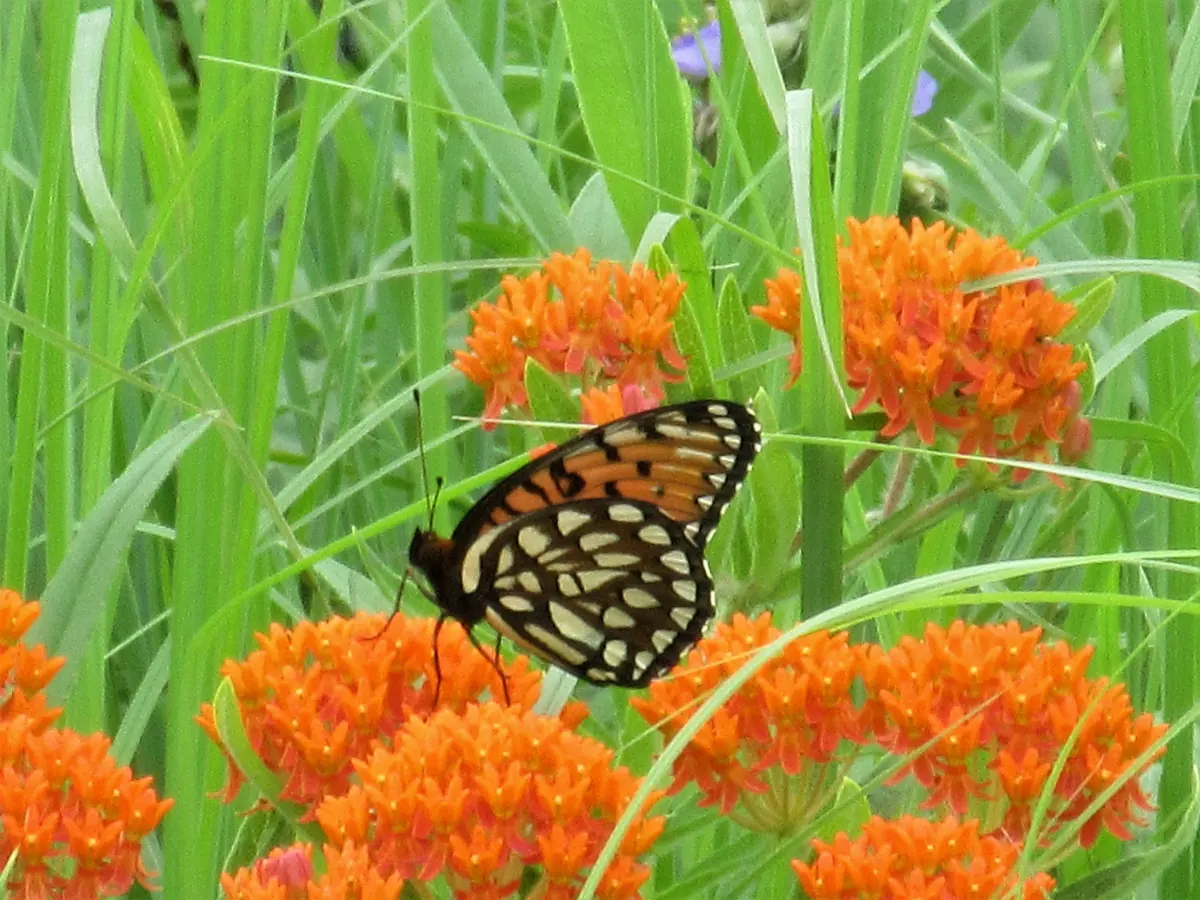
The regal fritillary (Argynnis idalia, formerly Speyeria idalia) is a large butterfly — wingspan 2.5 to 4 inches, making it one of the largest fritillaries in North America. Males have bright orange forewings with black markings and dark brown to black hindwings with a band of white spots near the outer margin and a second band of blue or blue-white spots. Females are darker, with the orange replaced by brownish-olive on the forewings. Both sexes have silver spots on the underside of the hindwings.
Adults fly from late June into early September. They are strong fliers, moving across prairie landscapes in search of nectar and mates. Males patrol extensively; females are less conspicuous and spend more time foraging for nectar and searching for violet plants on which to lay eggs.
Larvae feed exclusively on native violet species (Viola spp.). Females lay eggs near violet plants in late summer; larvae hatch and immediately enter winter dormancy without feeding, emerging the following spring to feed on violet leaves. This larval dependence on native violets means the species cannot persist in habitats where prairie violets have been eliminated — including grasslands converted to monoculture pasture, developed land, or areas where the native forb understory has been suppressed.
Habitat in Colorado
Native prairie remnants on Colorado’s eastern plains provide the combination of native violet species, diverse native forbs for adult nectar, and the open grassland structure that regal fritillaries require. Colorado records come mainly from the far eastern plains next to occupied areas in Kansas and Nebraska.
The species’ distribution on the eastern plains is poorly documented compared to its eastern range, reflecting both genuinely reduced abundance and the limited butterfly survey effort in Colorado’s grassland habitats.
Regal fritillary populations require large, connected patches of native prairie — not small, isolated fragments. The fragmentation of Colorado’s eastern plains native grassland into small parcels embedded in a matrix of cropland limits population size and connectivity in ways that increase extinction risk at individual sites.
Threats
Native prairie loss is the foundational threat. The conversion of native tallgrass and mixed-grass prairie to cropland, developed land, and planted pasture has eliminated the vast majority of the habitat the regal fritillary requires. The eastern extirpation correlates closely with the agricultural conversion of the eastern prairie belt.
Violet host plant decline parallels prairie loss. Native violets in the prairie understory are eliminated by cultivation, suppressed by fire exclusion in some contexts, and displaced by invasive plants. Without native violets, reproduction cannot occur.
Pesticide use — particularly aerial applications over grassland areas adjacent to cropland — kills adults and larvae and reduces the floral diversity that adults need for nectar.
Fire suppression allows shrub encroachment that progressively closes the open grassland structure the species requires, and the elimination of fire can suppress the forb diversity — including violets — that depends on periodic disturbance for maintenance.
Fragmentation reduces population sizes to levels vulnerable to local extinction and limits the genetic exchange between populations that maintains long-term persistence.
Recovery & Conservation
USFWS proposed in August 2024 to list the eastern subspecies (Argynnis idalia idalia) as endangered and the western subspecies (A. i. occidentalis, which includes Colorado) as threatened. As of September 2026, no final rule has been published. This profile will be updated upon finalization.
Recovery will require protecting and managing large native prairie remnants, restoring prairie connectivity where feasible, and ensuring native violet populations persist within occupied and potential regal fritillary habitat. The voluntary conservation of native prairie on private land — through programs like USDA CRP, NRCS grazing land programs, and conservation easements — is the most important mechanism available given that most remaining native prairie is privately owned.
What You Can Do
- Report regal fritillary observations from Colorado’s eastern plains to iNaturalist. Records from native prairie remnants, with dates and locations, are genuinely valuable for understanding the distribution of this declining species in Colorado.
- Support native prairie conservation through land trusts and conservation organizations working in eastern Colorado. The grassland remnants that support regal fritillary and the broader native prairie plant and animal community are irreplaceable once converted.
- Allow native violets to grow in prairie or meadow areas. Suppressing “weeds” in grassland strips can eliminate the violet populations that fritillary larvae require.
- Check the USFWS species page quarterly to see whether the proposed listing has been finalized.