Overview
The piping plover (Charadrius melodus) is a small, sand-colored shorebird barely larger than a sparrow — named for its distinctive, clear piping call that carries across open shorelines. It is one of North America’s most imperiled shorebirds, federally listed as threatened since 1985.
Three distinct breeding populations exist: the Great Lakes population (federally endangered), the Northern Great Plains population (federally threatened), and the Atlantic Coast population (federally threatened). Colorado sits at the southern edge of the Northern Great Plains breeding range. In Colorado, nesting is confined to reservoir shorelines in the lower Arkansas River valley. Migrants are occasionally seen along the Arkansas and South Platte drainages — making careful observers in the right places at the right time genuinely lucky.
Natural History
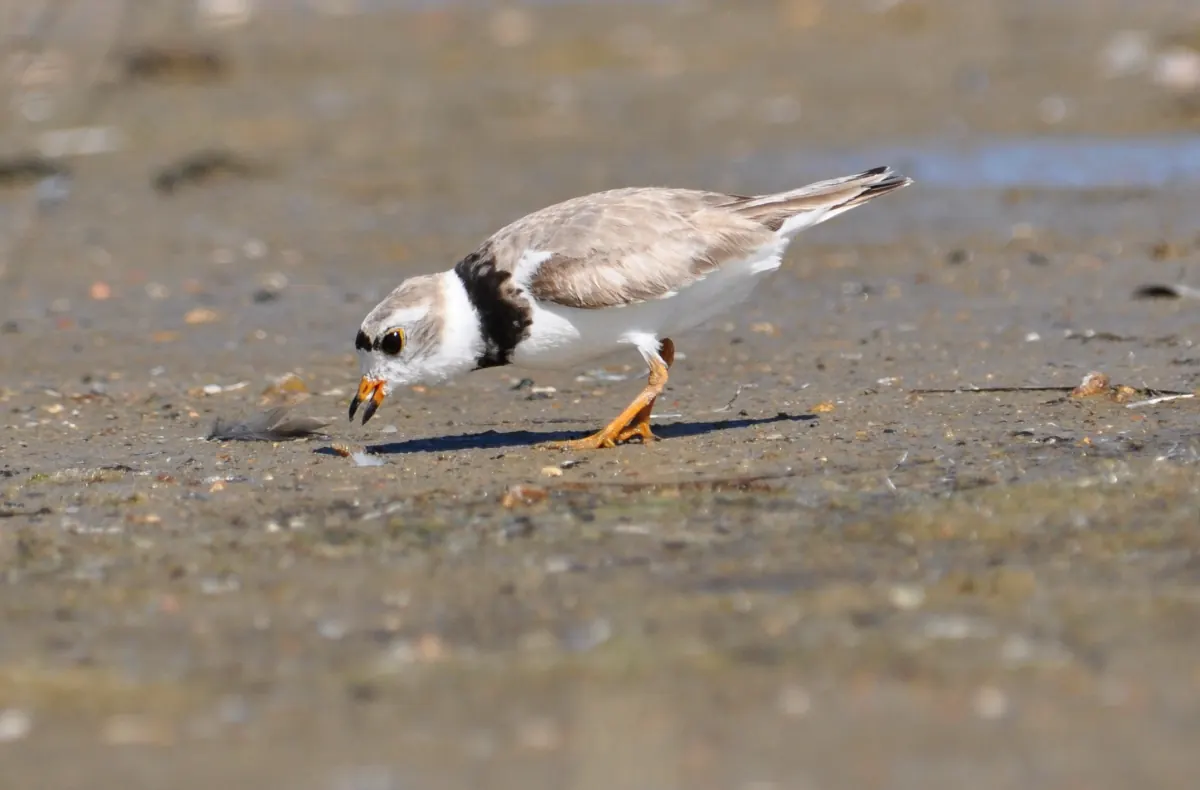
The piping plover measures approximately 7.25 inches in length with a compact, plover body shape and relatively short bill. Its plumage is a pale gray-brown — almost exactly the color of dry beach sand — which provides its primary defense against predation on the open shorelines where it nests. In breeding plumage, adults display bright orange legs, an orange bill tipped in black, a black breastband that may be complete or partial, and a black bar across the forehead. Outside of breeding season, the black markings fade and the bill darkens.
The species feeds on beach-dwelling invertebrates — insects, small crustaceans, and mollusks — foraging by sight along the water’s edge in a characteristic stop-run-tilt pattern common to plovers. Nests are simple scrapes on open sand or gravel with minimal or no surrounding vegetation; the bird relies entirely on cryptic coloration rather than cover to protect eggs and chicks. Eggs and newly hatched chicks are nearly invisible against bare sand to any eye that isn’t looking for them.
Habitat in Colorado
In Colorado, piping plovers are found in the eastern part of the state, at the ragged southern margin of the Northern Great Plains breeding range. In Colorado, nesting is confined to reservoir shorelines in the lower Arkansas River valley. Nesting has been documented at John Martin, Adobe Creek (Blue Lake), Nee Noshe, Nee Gronda, and Nee Skah reservoirs in Bent and Kiowa counties. John Martin is among the most consistently used. Surveys found between 4 and 9 nesting pairs in the 1990s and 2000; no recent public count exists. Elsewhere in eastern Colorado it is a very rare migrant.
USFWS designated critical habitat for the Northern Great Plains population in 2002 in Minnesota, Montana, North Dakota, South Dakota, and Nebraska; Colorado reservoirs were considered but not included. Nesting sites here are considered marginal relative to the core of the Northern Great Plains range, and some may function as demographic sink habitats — attracting birds without contributing proportionally to population productivity, due to elevated predation rates and the variable hydrology of reservoir and river systems at this latitude. That doesn’t make Colorado sites unimportant. Sink dynamics are poorly understood, range-edge populations may carry distinct genetic variation, and connectivity along migration corridors depends on stopovers being available.
Primary Threats
Water level fluctuations at reservoirs and regulated rivers represent the defining challenge for Colorado nesting sites. Nests placed on sandbars or reservoir beaches can be flooded or stranded — cut off from foraging habitat — by rapid water level changes. In the semi-arid West, reservoir management is driven by irrigation and municipal water demand, not nesting bird phenology.
Predation limits reproductive success at Colorado sites. American crows, ravens, coyotes, raccoons, and raptors all take eggs and chicks. On relatively small, isolated nesting beaches without the numerical dilution effect available at larger Northern Great Plains colonies, predation can eliminate entire nesting attempts.
Human disturbance is the dominant threat across the range. Recreational use of reservoir beaches — including off-road vehicles, foot traffic, and unleashed dogs — causes nest abandonment, egg breakage, and chick mortality. Piping plover chicks are precocial (mobile within hours of hatching) but small, cryptic, and completely unable to evade dogs.
Vegetation encroachment reduces the bare sand and sparsely vegetated shoreline habitat the species requires. Riparian shrubs and invasive grasses advancing onto sandbars and beaches are incompatible with nesting.
Livestock grazing directly on shoreline nesting areas can destroy nests by trampling and degrade habitat structure.
Recovery Efforts
Recovery is guided by the 1988 Great Lakes and Northern Great Plains recovery plan. USFWS released a draft revised plan for the Northern Great Plains population in 2016. A December 2024 USFWS five-year review kept the Northern Great Plains population listed as threatened.
Colorado Parks and Wildlife and U.S. Army Corps of Engineers staff monitor nests at John Martin Reservoir, and USGS color-banding studies from 2008 to 2022 included Colorado birds.
In Colorado, managers use nest exclosures and seasonal shoreline closures from early April through mid-August. Vegetation control and predator management at key nesting sites are also part of the work. The slow but real population growth since 1985 reflects what sustained, unglamorous management work can accomplish.
What You Can Do
- Report sightings to iNaturalist and eBird — migration records from Colorado carry real scientific value, and any nesting observation should be reported to Colorado Parks and Wildlife promptly.
- Respect posted nesting closures at eastern Colorado reservoirs from April through mid-August. If a stretch of shoreline is roped off, the reason is almost always a nest you cannot see.
- Keep dogs leashed near shorelines during nesting season. A single off-leash dog working a beach can end a nesting attempt that took weeks to establish.
- If you recreate along the Arkansas or South Platte drainages in spring and summer, give any plover you see a wide berth and watch from a distance.
- Support riparian and shoreline habitat conservation along the Arkansas and South Platte drainages — the connectivity these corridors provide for migration matters as much as the nesting sites themselves.