Quick facts
- Wolverines in Colorado
- No established population; one confirmed since 1919 (M56)
- Planned releases
- Up to 45, about 15 per season for 3+ seasons
- Release zones
- North of I-70 incl. Rocky Mountain National Park; Elk and West Elk Mountains; San Juan Range
- Federal status
- Threatened (since November 30, 2023)
- State status
- Endangered
- Main threat
- Loss of deep spring snowpack
Reintroduction pending. Colorado Parks and Wildlife released a formal Wolverine Restoration Plan in January 2026, calling for the release of up to 45 wolverines. No animals have been released yet; a federal 10(j) nonessential experimental population rule is required before the first release can proceed.
Overview
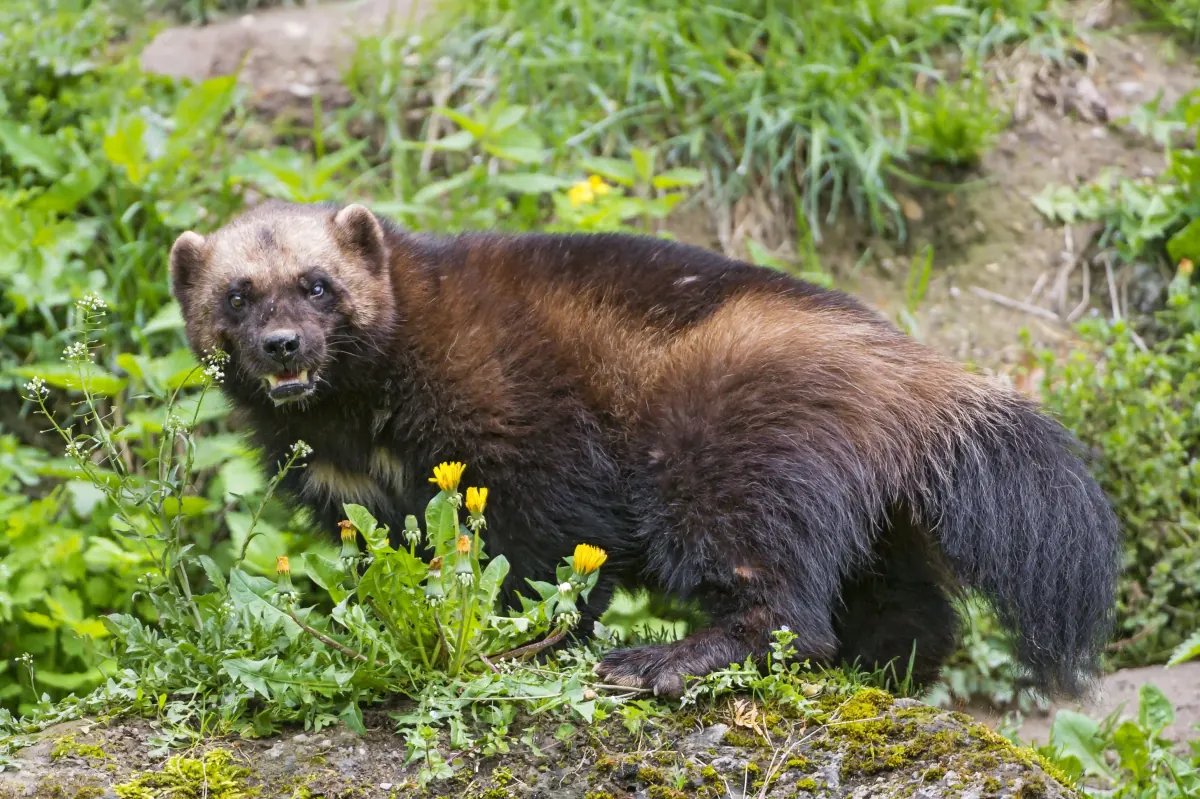
The wolverine (Gulo gulo) is the largest land-dwelling member of the weasel family — a muscular, bear-faced predator that looks improbable and behaves accordingly. It crosses mountain ranges in days. It drives grizzly bears off kills. It travels routes that would exhaust a backcountry skier. For an animal that weighs less than 40 pounds, it occupies an almost mythological space in the ecology of the high Rockies.
In Colorado, wolverines occupy a peculiar conservation status: protected but, for now, absent. Only one wolverine has been confirmed in Colorado since 1919: M56, a collared male who walked from Wyoming’s Togwotee Pass area into north-central Colorado in 2009. CPW tracked him until 2012; he was shot in North Dakota in 2016. He was a single documented disperser from Wyoming — a scout, in effect, testing whether Colorado’s alpine landscape can support a breeding population. No breeding has been documented in the state.
That framing is changing. Colorado passed Senate Bill 24-171 in May 2024, authorizing CPW to reintroduce wolverines to the state. On January 15, 2026, CPW released a formal Wolverine Restoration Plan — a 106-page document planning for the release of up to 45 wolverines, up to 15 per winter over three or more winters, favoring pregnant females, into Colorado’s high country. No animals have been released yet; the program is working through required state and federal steps before the first release.
After nearly three decades of legal battles, petitions, and withdrawn listing proposals, the U.S. Fish and Wildlife Service listed the wolverine as Threatened under the Endangered Species Act in November 2023. The listing explicitly identified climate change — specifically the loss of persistent spring snowpack — as the primary driver of decline.
Habitat in Colorado
Wolverines are creatures of the high country in the most literal sense. Suitable habitat in Colorado is subalpine and alpine terrain — spruce-fir forest, krummholz, and alpine tundra — where snow lingers well into spring.
What makes habitat suitable is not just elevation but snowpack. Female wolverines den in deep spring snow, excavating tunnels that can extend 10 feet or more beneath the surface. The snow serves as insulation — keeping den temperatures stable while kits develop — and the den must hold through April and May when cubs are most vulnerable. Research has tied wolverine reproduction to snow cover that persists into mid-May, which females need for dens. Colorado’s highest terrain currently provides this, but modeled projections suggest significant portions of that habitat become marginal by mid-century under most climate scenarios.
Males require enormous home ranges — often 200 to 500 square miles — which means suitable Colorado habitat must connect to larger populations to the north. Isolated mountain ranges surrounded by lower-elevation terrain act as barriers to dispersal.
Primary Threats
Climate change and snowpack loss is the threat that drove the 2023 federal listing. Wolverines are among the most climatically vulnerable mammals in North America because their reproductive biology is physically tied to deep spring snow. As snowpack arrives later, melts earlier, and decreases in depth across the Rockies, the window of suitable denning conditions contracts. Models project roughly a third of wolverine habitat in the contiguous United States lost by mid-century and about two-thirds by late century (McKelvey et al. 2011). In Colorado, this compression occurs from below — as lower treeline sites warm, the band of suitable habitat retreats upslope toward summits that offer diminishing returns in terms of area.
Isolation and low connectivity compounds the climate threat. Colorado’s only confirmed wolverine in the past century was a single documented disperser from Wyoming. For a breeding population to establish in Colorado, animals must successfully navigate hundreds of miles of fragmented terrain — crossing highways, developed areas, and lower-elevation habitat that wolverines typically avoid. A female making this journey is extraordinarily rare.
Low reproductive rate means any losses are slow to recover. Females typically breed every two years, producing litters of two to three kits. A population absorbing consistent adult mortality — from trapping, vehicle strikes, or habitat loss — cannot replace losses quickly.
Historical trapping is why the state starts from zero. Poisoning, trapping, and unregulated killing eliminated wolverines from Colorado; the last confirmed record before M56 was in 1919. No population has returned on its own in the century since.
Recovery and Conservation Status
The November 2023 Threatened listing was the culmination of a process that began with the first formal listing petition in 1994. USFWS proposed listing in February 2013 and withdrew the proposal in August 2014. A federal court vacated that withdrawal in April 2016; USFWS withdrew again in October 2020, and a court vacated that decision in May 2022. The final threatened listing was published November 30, 2023 — the first durable federal protection wolverines have received.
Colorado moved quickly after the listing. In May 2024, Governor Polis signed Senate Bill 24-171, authorizing CPW to reintroduce wolverines to the state. The legislature committed about $1.8 million over four fiscal years, including $750,000 from the Species Conservation Trust Fund. On January 15, 2026, CPW released its formal Wolverine Restoration Plan — a 106-page document detailing the framework for releasing up to 45 wolverines, up to 15 per winter over three or more winters, favoring pregnant females, into Colorado’s high country. CPW ranked central and southern Alberta and British Columbia as the best source populations and identified three release zones: north of I-70 including Rocky Mountain National Park, the Elk and West Elk mountains, and the San Juans.
Colorado holds an estimated 20 percent of all modeled wolverine habitat in the contiguous United States, according to CPW’s restoration plan, making it one of the most significant potential recovery sites for the species anywhere in its lower-48 range.
No release date has been set. Before animals can be moved, CPW must finalize a livestock depredation compensation rule and USFWS must issue a federal 10(j) nonessential experimental population rule. Colorado law (SB 24-171) bars releases until that rule takes effect; as of September 2026, none has been proposed, and no wolverines have been released.
Critical habitat has not yet been designated for the wolverine. USFWS issued a recovery outline in December 2023; no recovery plan has been completed.
CPW monitors wolverine presence through remote camera networks and winter track surveys. The state’s wolverine program is now formally structured around restoration rather than passive monitoring.
What You Can Do
- If you observe what you believe is a wolverine in Colorado, report it to Colorado Parks and Wildlife through their wildlife observation system at CPW’s wolverine sighting form. Wolverine detections are rare and scientifically valuable; CPW biologists will follow up. A general area description — mountain range, wilderness unit, or county — is sufficient.
- Support snowpack and climate policy. Wolverine recovery in Colorado is inseparable from the trajectory of the Rocky Mountain snowpack. Organizations working on Western water and climate policy are effectively working on wolverine habitat.
- Follow CPW’s wolverine reintroduction process. Public comment opportunities will arise as CPW finalizes the livestock compensation rule and other steps required before releases occur. Engaged public support for the reintroduction is meaningful.
- Practice low-impact winter recreation in wolverine country. CPW’s three planned release zones — north of I-70 including Rocky Mountain National Park, the Elk and West Elk mountains, and the San Juans — are the most likely areas for future wolverine activity in Colorado. Staying on established routes during late winter and spring minimizes disturbance during the period when wolverines, if present, would be denning.
Frequently asked questions
- Are there wolverines in Colorado?
- No established population. Only one wolverine has been confirmed in Colorado since 1919: M56, a collared male who walked in from Wyoming in 2009 and was tracked by CPW until 2012.
- When will wolverines be reintroduced to Colorado?
- No date has been set. CPW's Wolverine Restoration Plan, released January 15, 2026, calls for up to 45 wolverines, about 15 per season for three or more seasons, but a federal 10(j) nonessential experimental population rule must be finalized before releases begin. As of September 2026, no federal 10(j) rule had been proposed and no wolverines had been released.
- Where would wolverines be released in Colorado?
- In three zones: north of I-70, including Rocky Mountain National Park; the Elk and West Elk Mountains between I-70 and Highway 50; and the San Juan Range. CPW estimates Colorado could eventually support about 100 wolverines.
- Why are wolverines threatened?
- Mainly because of the loss of deep spring snowpack. Female wolverines den in snow that persists into mid-May, and as snowpack arrives later, melts earlier and gets shallower, the window of suitable denning conditions shrinks. The 2023 federal listing named this loss of persistent spring snowpack as the primary driver of decline.