Quick facts
- Status
- Federally endangered; state endangered
- Wild population
- About 300 across North America (USFWS)
- Released in Colorado
- More than 500 since 2001
- Habitat
- Prairie dog colonies on shortgrass and mixed-grass prairie
- Diet
- Prairie dogs, about 90% of the diet; 100+ a year
- Biggest threat
- Sylvatic plague
Overview
The black-footed ferret (Mustela nigripes) is one of North America’s most endangered mammals — and one of conservation’s most remarkable second-chance stories. Presumed extinct in 1979, it was rediscovered two years later when a ranch dog in Meeteetse, Wyoming brought home a dead one. That discovery launched one of the most intensive recovery programs in the history of the Endangered Species Act, producing thousands of captive-bred animals and reintroduction sites across eight U.S. states, Canada, and Mexico. Colorado has been a reintroduction state since 2001 and has released more than 500 ferrets.
Natural History
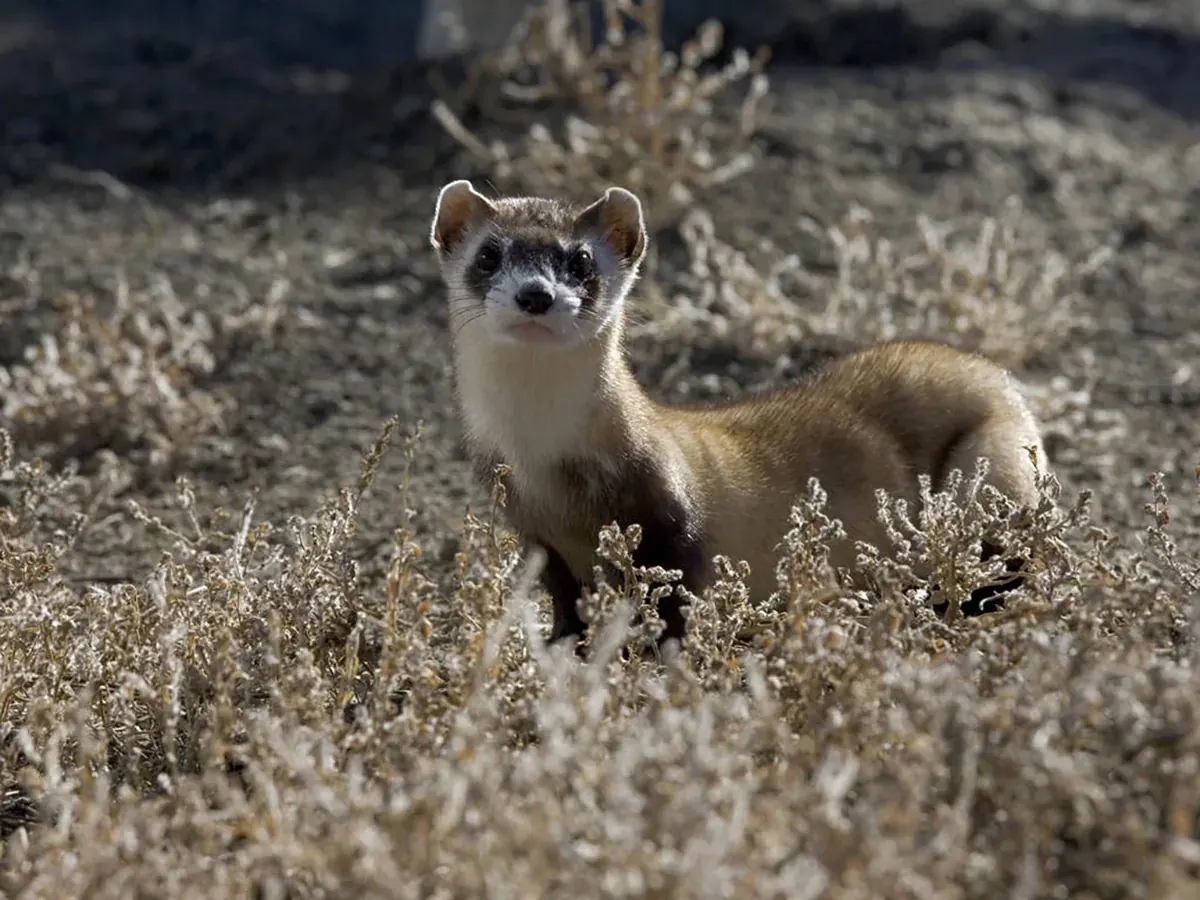
The black-footed ferret (Mustela nigripes) is a slender mustelid roughly the size of a mink, with a distinctive black facial mask, black feet, and a black-tipped tail set against a pale yellowish-buff body. Adults weigh about 1.4 to 2.5 pounds and measure 18 to 24 inches from nose to tail. They are solitary, secretive, and almost entirely nocturnal, spending the vast majority of their lives underground. Breeding occurs in March and April; litters of three to four kits are born in May and June, and young animals disperse in late summer to establish their own territories within prairie dog colonies. The diet is almost exclusively black-tailed prairie dogs — studies suggest prairie dogs make up roughly 90 percent of the diet — and a single ferret requires more than 100 prairie dogs a year to survive.
The Prairie Dog Foundation
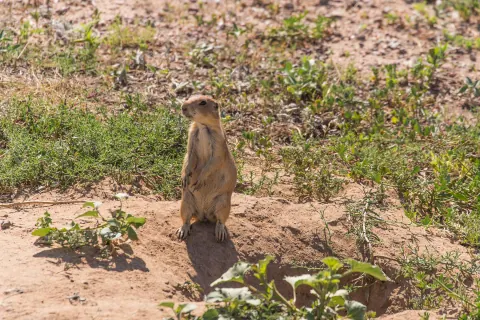
To understand the black-footed ferret is to understand its relationship with the black-tailed prairie dog. Ferrets do not merely eat prairie dogs — they live inside them. Prairie dog burrow systems serve as ferret dens, maternity sites, escape tunnels, and hunting grounds. A prairie dog town is, for a ferret, a complete world. This dependency means that ferret conservation is inseparable from prairie dog conservation: a colony collapse from plague, poison, or habitat loss removes not just the food supply but the physical infrastructure of ferret existence. Recovery managers must think in terms of entire prairie dog complexes — contiguous colonies of several thousand acres or more — rather than individual animals or small habitat patches. On Colorado’s eastern plains and a few protected Front Range grasslands, colonies of that scale still exist. Maintaining them is the central conservation challenge.
Habitat in Colorado
Black-footed ferrets in Colorado live on black-tailed prairie dog colonies at a scattered network of release sites rather than in a single region. The state’s first releases were in the northwest, at Wolf Creek and Coyote Basin in Rio Blanco and Moffat counties, where 260 ferrets were released between 2001 and 2008 before plague ended the effort.
A 2013 state law allowing releases on private land under Safe Harbor agreements moved the program to the eastern plains and Front Range. Since then, ferrets have been released at Rocky Mountain Arsenal National Wildlife Refuge on the edge of the Denver metro area, at the City of Fort Collins’ Soapstone Prairie Natural Area near the Wyoming border, at Walker Ranch and the Pueblo Chemical Depot in Pueblo County, and on private ranches in Prowers and Baca counties, including the Southern Plains Land Trust’s Heartland Ranch. Not every site has held: plague collapsed prairie dog colonies at several eastern-plains sites in the mid-2010s. CPW does not publish a statewide ferret count.
Where to see one: Rocky Mountain Arsenal National Wildlife Refuge in Commerce City has a live black-footed ferret exhibit at its visitor center. Check the refuge’s current hours before you go — wild ferrets are nocturnal and rarely seen.
Threats
Sylvatic plague is the single greatest threat to black-footed ferret recovery in Colorado and across the range. The disease is caused by Yersinia pestis, a bacterium introduced to North America in the early twentieth century and not part of the ecological history that prairie dogs and ferrets evolved within. Plague kills both species with devastating efficiency — a single epizootic can collapse an entire prairie dog colony in a matter of weeks, and ferrets have no natural resistance. No reintroduction site is fully safe from plague, and the disease remains the primary reason ferret recovery has not achieved self-sustaining populations at most sites.
Habitat loss and fragmentation has reduced and isolated the vast prairie dog complexes that once defined the southern Great Plains. Agricultural conversion, road construction, urban expansion, and decades of systematic prairie dog poisoning and shooting have eliminated an estimated 95 percent of historical prairie dog habitat across the West, leaving ferret reintroduction managers working with a fraction of the landscape the species evolved to occupy.
Genetic bottleneck is a long-term vulnerability. All living black-footed ferrets descend from the 18 survivors of the ferrets captured at Meeteetse between 1985 and 1987 — and only seven of those contributed genes to today’s population. That creates an unusually narrow genetic base that limits adaptive capacity and increases susceptibility to disease and inbreeding depression. Recovery managers have worked to maintain genetic diversity within the captive population through careful breeding management for four decades.
Recovery & Conservation
The Black-footed Ferret Recovery Program is among the most intensive in ESA history, involving USFWS, state wildlife agencies, tribal nations, zoos, and private landowners across the range. The U.S. Fish and Wildlife Service’s National Black-footed Ferret Conservation Center in Carr, north of Fort Collins, is the nation’s largest ferret breeding center and holds about two-thirds of the captive population, and the Cheyenne Mountain Zoo in Colorado Springs participates in the Species Survival Plan. Managers protect release sites by dusting prairie dog burrows with insecticide to kill plague-carrying fleas and by scattering peanut-butter-flavored oral vaccine baits that prairie dogs eat. Drone delivery of vaccine baits has been tested in pilot projects.
Elizabeth Ann, the first cloned U.S. endangered species, was born on December 10, 2020, at the National Black-footed Ferret Conservation Center in Carr, Colorado, and announced in February 2021. She was cloned from cells of a ferret named Willa, frozen in 1988. Two more clones, Noreen and Antonia, followed in 2023, and in 2024 Antonia gave birth at the Smithsonian’s Front Royal, Virginia, facility — the first time a cloned U.S. endangered species has reproduced.
What You Can Do
- Report sightings to CPW. Black-footed ferrets are nocturnal; their eyes reflect a distinctive bright green under a spotlight on the prairie at night. Any confirmed sighting in Colorado is scientifically valuable — contact Colorado Parks and Wildlife.
- Support prairie dog conservation. Landowners can get cost-share support for ferret-friendly prairie dog management through NRCS Colorado’s Black-footed Ferret Initiative (EQIP).
- Advocate for plague management funding. The oral plague vaccine program requires sustained federal investment. Prairie dog colonies without active plague management remain vulnerable regardless of how many ferrets are released into them.
Frequently asked questions
- How many black-footed ferrets are left?
- About 300 live in the wild across North America, according to the U.S. Fish and Wildlife Service. Colorado has released more than 500 ferrets since 2001, but Colorado Parks and Wildlife does not publish a statewide count.
- Why are black-footed ferrets endangered?
- Mostly because of sylvatic plague, which can collapse an entire prairie dog colony in a matter of weeks and kills ferrets too. An estimated 95 percent of historical prairie dog habitat across the West has been lost, and only seven ferrets contributed genes to today's population, leaving an unusually narrow genetic base.
- Where do black-footed ferrets live in Colorado?
- On black-tailed prairie dog colonies at scattered release sites, including Rocky Mountain Arsenal National Wildlife Refuge, Soapstone Prairie Natural Area, the Pueblo Chemical Depot and private ranches in Prowers and Baca counties. Rocky Mountain Arsenal, in Commerce City, also has a live black-footed ferret exhibit at its visitor center.
- What biome do black-footed ferrets live in?
- Grasslands. The U.S. Fish and Wildlife Service says black-footed ferrets inhabit the intermountain prairies and grasslands, where they live on prairie dog colonies and use prairie dog burrows as dens, maternity sites and hunting grounds.
- What adaptations help black-footed ferrets survive?
- A slender, wiry body and short legs with large front paws and claws developed for digging, according to the U.S. Fish and Wildlife Service. Ferrets also have the largest canines of any North American mammal in proportion to body size, and they are nocturnal and spend most of their lives underground.