What it is
Chytrid fungus, Batrachochytrium dendrobatidis or Bd, infects the keratin in amphibian skin. The disease it causes, chytridiomycosis, thickens the skin and upsets the body’s salt balance, which can end in cardiac arrest.
The fungus was described by Berger et al. in 1998 and named by Longcore, Pessier and Nichols in 1999. Genetic work traces Bd to East Asia, with the Korean Peninsula lineage closest to its ancestor. It spread worldwide 50 to 120 years ago through international trade, including the pet trade.
Worldwide, chytridiomycosis contributed to the decline of “at least 501 amphibian species over the past half-century, including 90 presumed extinctions.” North America has seen relatively few chytrid-driven declines, which makes Colorado’s boreal toad losses stand out.
How it spreads
Bd releases swimming spores, called zoospores, that move through water to new hosts. It grows best at about 17–25 °C (62–77 °F).
In Colorado
- 1991–1999: At four monitored Colorado sites, male boreal toad survival fell from an average of 78% in 1991–94 to 45% in 1995 and 3% in 1998–99. Researchers identified Bd as a proximate cause.
- 1999: In the words of a CPW report, “After the discovery of Bd in Colorado, and the associated die-off of boreal toads in Clear Creek County in 1999,” the Boreal Toad Recovery Team decided to establish disease-free captive stocks.
- June 2001: Bd was detected in wood frogs and boreal chorus frogs in the Kawuneeche Valley of Rocky Mountain National Park, from specimens collected that month.
- 2008: A Rocky Mountain survey detected Bd at 64% of site clusters, from 1,030 to 3,550 meters in elevation. It sampled 1,247 amphibians at 261 locations.
Effects on wildlife
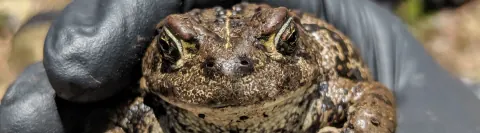
In Colorado, chytrid fungus is the main reason the boreal toad is state endangered. At the four monitored sites, male survival fell from an average of 78% to 3% within a decade.
Bd is not limited to toads. In Rocky Mountain National Park it was found in wood frogs and boreal chorus frogs, and the Rocky Mountain survey found it across a wide range of elevations, from 1,030 to 3,550 meters.
What’s being done
Raising toads
CPW’s John W. Mumma Native Aquatic Species Restoration Facility in Alamosa houses more than 700 adult boreal toads and has raised 133,546 tadpoles, toadlets and adults for release. The boreal toad profile covers the release programs.
A probiotic
CU Boulder researchers led by Valerie McKenzie restored the skin bacterium Janthinobacterium lividum to captive-raised boreal toads at the Alamosa facility. The treatment gave a 40 percent increase in survival when the toads were later exposed to Bd.
Keeping a second fungus out
Bsal, Batrachochytrium salamandrivorans, is a related fungus that attacks salamanders. It has not been detected in the wild in the United States. It came to Europe through the Asian salamander trade, where fire salamanders in the Netherlands fell 96% from 2010 to 2013. In 2016, USFWS listed 201 salamander species as injurious wildlife to keep Bsal out, and a 2025 rule expanded the listing to 36 genera.
Does it affect people?
No. The disease is not known to affect humans.
How you can help
- Clean, drain and dry boots, waders and nets between wetlands.
- Never move amphibians or water from one site to another.
- Never release pet amphibians.
- Report sick or dead amphibians to CPW. CPW requires scientific collectors to disinfect equipment between sites.