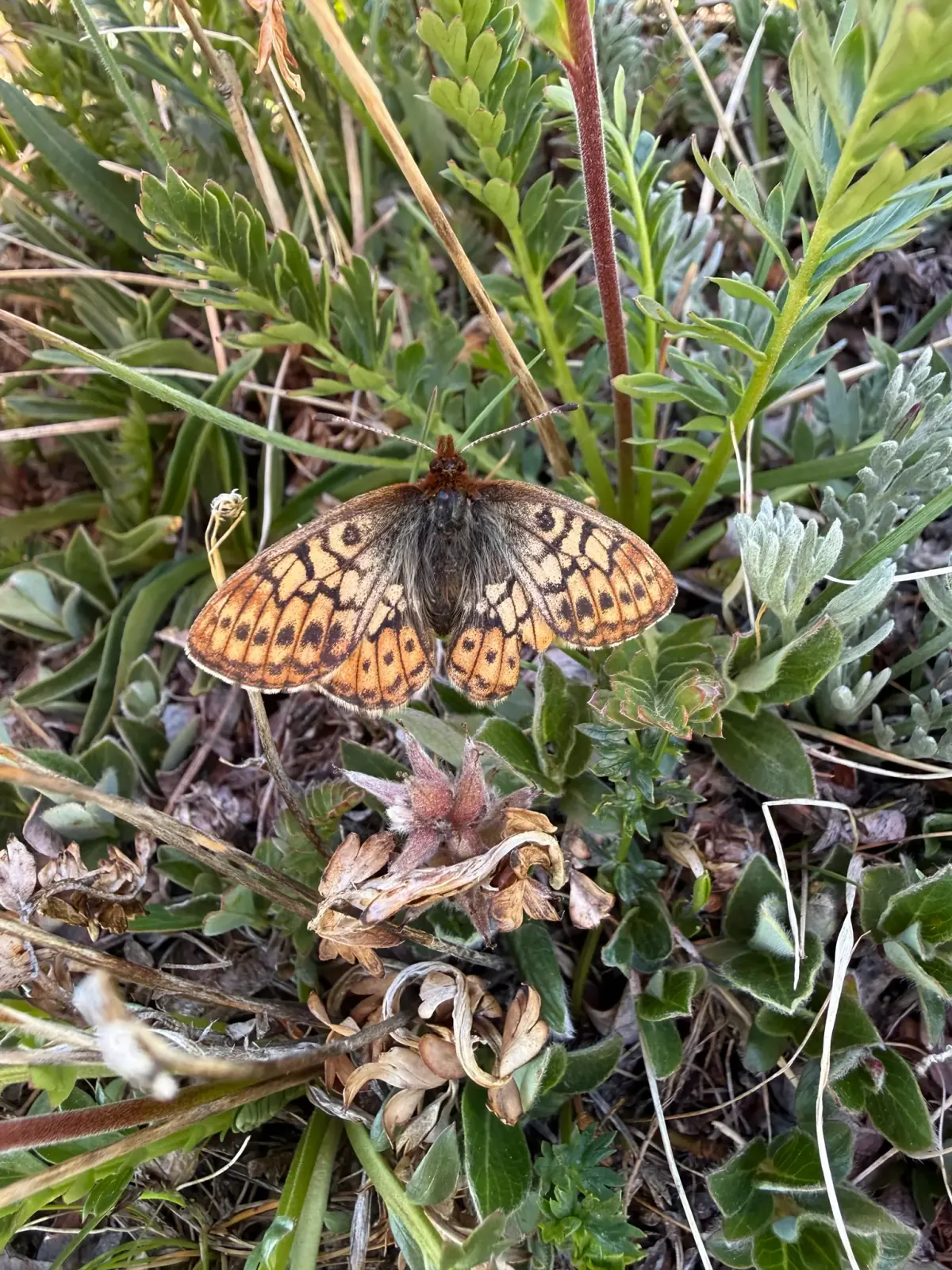
Overview
The Uncompahgre fritillary exists at the intersection of extreme geographic restriction and existential climate threat. Its entire world range consists of up to 11 small colonies on northeast-facing alpine slopes in the San Juan Mountains of southwestern Colorado, between about 12,100 and 13,500 feet. It is among the most geographically restricted butterflies in North America and one of the most restricted animal species on the continent.
It was listed as endangered on June 24, 1991. The listing recognized what was already clear: a species whose entire existence occupies a handful of alpine colonies has essentially no margin for error. One bad fire, one prolonged drought, one pathogen, one sufficient warming trend — any of these things hitting at the right scale and the right time could eliminate the species entirely. It is a Tier 1 Species of Greatest Conservation Need in Colorado’s State Wildlife Action Plan; Colorado’s state endangered list does not cover insects.
Climate change is that threat at scale. The Uncompahgre fritillary is completely dependent on snow willow (Salix nivalis), a prostrate alpine shrub found only in patches of persistent late-season snowpack at and above 12,000 feet. As Colorado’s alpine snowpack declines and the growing season shifts, snow willow habitat is contracting upslope toward summits that already represent the highest available ground.
Natural History
The Uncompahgre fritillary (Boloria acrocnema) is a small, dark butterfly — wingspan about 2 to 3 centimeters (roughly one inch) — with orange-brown wings marked with darker brown to black spotting and checkered patterns typical of the Boloria fritillaries. It is not a showy insect by butterfly standards. What it lacks in visual drama it compensates for in the remarkable specificity of its ecological requirements.
Adults fly for approximately two to three weeks in July and early August — the brief window when conditions on the high San Juan summits allow adult butterfly activity. The flight window is constrained by both the late spring snowmelt and the early autumn frosts that bookend the alpine summer. In bad years — early or late snow, extended cold periods in July — adult emergence may be greatly reduced or cut short.
Larvae feed exclusively on snow willow (Salix nivalis), a ground-hugging willow that forms low mats in areas where deep late-season snowpack maintains soil moisture through the alpine summer. This plant is found only where specific combinations of aspect, elevation, and topographic position create persistent snowpack conditions. The butterfly cannot reproduce where its host plant does not grow. Its host plant cannot grow where snowpack does not persist. Its snowpack is declining. Most larvae take two years to mature, and some take up to four, so adult counts swing widely from year to year.
Adults nectar on whatever alpine tundra flowers are available in the brief summer window — various composites, phlox, and other high-altitude forbs.
Habitat in Colorado
The colonies in the San Juan Mountains that constitute the species’ entire range are all above 12,000 feet, in the alpine tundra zone above treeline. The specific habitat within those colonies is even more restricted: patches of snow willow growing on northeast-facing slopes where late snowpack creates the persistent soil moisture conditions the plant requires.
No critical habitat has been designated. The occupied sites are on Forest Service and BLM land, so federal actions that might affect the butterfly still require consultation with USFWS.
Counts at the three monitored colonies mostly ranged from 3,500 to 9,900 adults between 2003 and 2017, swinging widely from year to year.
Threats
Climate change is the existential threat. Alpine snowpack in the San Juan Mountains is declining — earlier snowmelt, warmer summer temperatures, and more variable precipitation are all reducing the extent and duration of the late-season snowpack conditions that snow willow requires. As snow willow habitat contracts, the butterfly’s available breeding area contracts with it. The mountain peaks themselves are fixed; the butterfly cannot move upslope beyond the summits. There is no higher ground.
USFWS’s 2018 status review identified climate change as a discernible, impactful threat, and field research links the butterfly’s abundance to soil moisture and alpine plant cover. For a species confined to a handful of alpine colonies, even modest habitat contraction reduces population size toward minimum viable thresholds.
Trampling and grazing: Foot traffic and livestock can damage snow willow patches and disturb adults during the short flight season. Historically, butterfly collecting was also a threat; it is now controlled.
Extremely small range is itself a threat: any stochastic event — a wildfire reaching the summits, an introduced pathogen, an unusually severe weather sequence — hitting the entire range simultaneously could cause extinction. There is no source population elsewhere.
Recovery & Conservation
The Uncompahgre fritillary was listed as endangered on June 24, 1991. No critical habitat has been designated. A recovery plan was approved in 1994. USFWS’s 2009 review suggested downlisting to threatened, but the most recent five-year review (2018) recommended keeping it endangered. Recovery efforts focus on monitoring the population, protecting occupied habitat from disturbance, and researching the species’ responses to changing climate conditions.
The fundamental recovery challenge — slowing or reversing alpine snowpack decline — is not addressable through local management. It requires the broader societal response to climate change that would reduce greenhouse gas emissions at a scale sufficient to alter alpine snowpack trajectories across the Rocky Mountain region.
What can be done locally is protecting the remaining habitat from non-climate threats: limiting trampling and grazing in occupied areas, minimizing other sources of disturbance, and maintaining the monitoring programs that track population trends.
What You Can Do
- Stay on trails in the San Juan Mountains alpine zone above treeline. Snow willow patches are fragile and slow to recover from physical disturbance.
- Report observations from San Juan Mountains alpine peaks during July to iNaturalist. Adult Uncompahgre fritillary observations, with date and specific location, contribute to population monitoring.
- Support climate action at every scale available. The Uncompahgre fritillary’s survival is, in the most direct sense, a function of whether greenhouse gas emissions are reduced enough to slow alpine snowpack decline across the Rockies.
- Support the San Juan Mountains wilderness and wildland protections that keep the occupied colonies free from the development and motorized use that would add non-climate threats to the species’ already precarious situation.