Overview
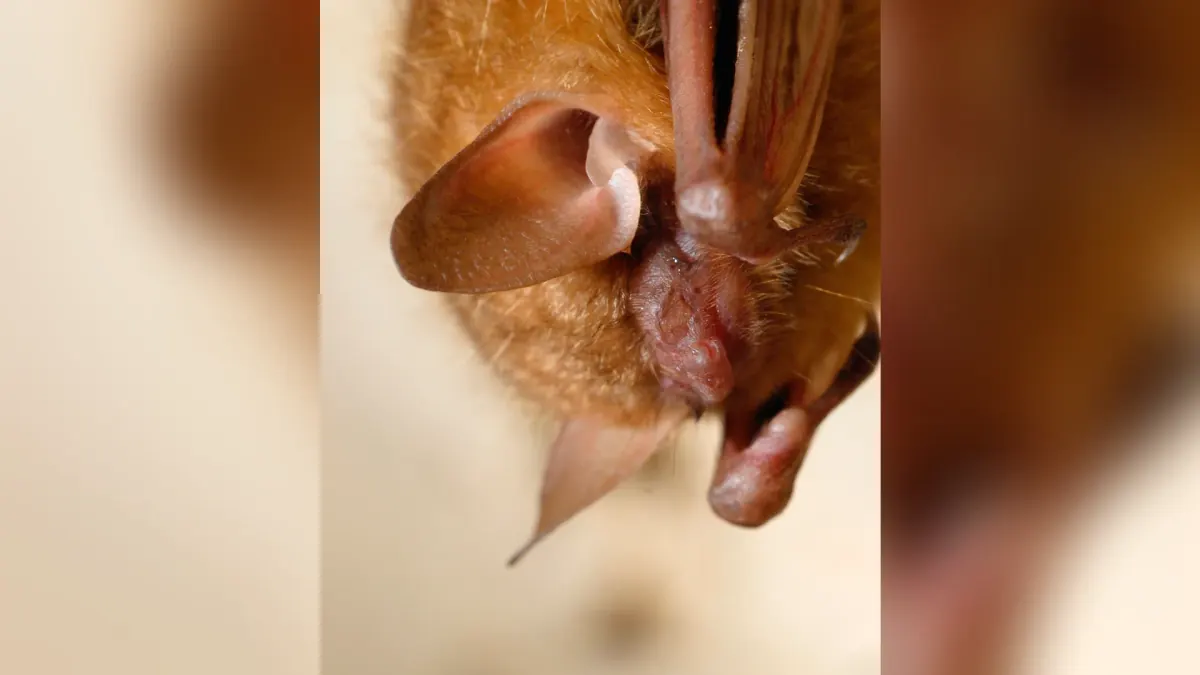
The tricolored bat is a tiny eastern bat that white-nose syndrome has devastated, and USFWS proposed listing it as federally endangered in 2022. In Colorado it is rare and only recently documented, with a handful of Front Range records.
The U.S. Fish and Wildlife Service published its proposal on September 14, 2022. As of September 2026, USFWS had not published a final listing decision.
The tricolored bat is not on Colorado’s threatened and endangered list. CPW’s species page still mentions only a single Colorado report, from Greeley, and the Colorado Bat Working Group describes the species as an accidental occurrence here.
Natural History
The tricolored bat is about 3 to 3.5 inches long and weighs 0.16 to 0.28 ounces, with a wingspan of about 8 inches (210 mm).
It is named for its fur: each hair is dark at the base, lighter in the middle and dark at the tip.
It comes out early, while it is still light, to hunt small insects such as moths, flies and beetles over clearings and still water. Its flight is slow, erratic and fluttery.
In summer, the tricolored bat roosts among leaf clusters in deciduous trees. It hibernates in caves and mines.
Females usually have twins, in late spring or early summer. The oldest known tricolored bat was recorded 14.8 years after it was first banded.
Range
The tricolored bat is found in 39 states and the District of Columbia, four Canadian provinces, and Mexico and Central America. It is mainly a bat of eastern North America.
Tricolored Bats in Colorado
The tricolored bat is not on Colorado’s threatened and endangered list. CPW’s species page still mentions only a single Colorado report, from Greeley, and the Colorado Bat Working Group describes the species as an accidental occurrence here.
Recent research has added more records.
New records and reproduction
A 2018 paper by Rick Adams and colleagues reported new tricolored bat records in Boulder and Weld counties, with the first evidence of reproduction in Colorado. The authors suggested the species may be expanding westward and that “the Rocky Mountain West may provide at least a temporary refugium” from white-nose syndrome.
Acoustic detections
A 2024 study in the Journal of Mammalogy by Bevan Zientek, Colpitts and Adams reported that the first acoustic detection in Boulder County was in 2012. In August 2017, detectors along South Boulder Creek recorded 707 tricolored bat passes over 10 nights.
High-elevation forests
From June 1 to August 14, 2020, detectors in lodgepole pine forest on the Roosevelt National Forest, at about 8,900–9,300 feet (2,705–2,827 m), recorded 439 passes. The authors called this the first documentation of the species in Colorado’s high-elevation forests.
A “pass” is a recording of bat calls, not a count of bats.
Primary Threats
White-nose syndrome
White-nose syndrome is a fungal disease first seen in New York in 2006. It has caused estimated declines of 90–100% across 59% of the tricolored bat’s range, and USFWS projected an 89% range-wide decline by 2030.
Other threats
USFWS also lists wind turbine collisions, loss and disturbance of roosting habitat, and climate change.
White-nose syndrome in Colorado
The fungus that causes the disease was first detected in Colorado in July 2022, at Bent’s Old Fort National Historic Site in Otero County, and was also found in Baca, Larimer and Routt counties. The first confirmed case of the disease in Colorado was an adult female bat found unable to fly at Bent’s Old Fort in April 2023. In April 2025, the fungus was confirmed on the west side of Rocky Mountain National Park, in Grand County.
Colorado has 19 native bat species, and at least 13 may be susceptible.
Recovery & Conservation
Proposed federal listing
USFWS proposed listing the tricolored bat as endangered on September 14, 2022 (87 FR 56381). It found that designating critical habitat was “not prudent.” As of September 2026, USFWS had not published a final listing decision.
Rankings
NatureServe ranks the tricolored bat G3G4 range-wide and S2, imperiled, in Colorado.
What You Can Do
- Stay out of closed caves and mines, and decontaminate boots and gear before and after visiting caves.
- Don’t touch bats. Report sick or dead bats to CPW at 303-291-7771.
- Check stored gear. Look inside folded canopies and other stored outdoor gear for roosting bats before use.
- Know the risk to people. White-nose syndrome does not make people sick.
Sources
- Federal Register (2022), proposed endangered species status for the tricolored bat
- USFWS, tricolored bat species page
- NatureServe Explorer, tricolored bat
- CPW, threatened and endangered wildlife list
- CPW, tri-colored bat species page
- Colorado Bat Working Group, tricolored bat profile
- Adams et al. (2018), Western North American Naturalist
- Bevan Zientek, Colpitts and Adams (2024), Journal of Mammalogy
- Colorado Public Radio (2023), first case of white-nose syndrome in Colorado
- National Park Service (2025), fungus linked to white-nose syndrome detected in Rocky Mountain National Park