Overview
The Pawnee montane skipper has an extremely small geographic range. Its entire known world range is about 23 miles long and 5 miles wide in the South Platte River drainage of Douglas, Jefferson, Teller, and Park counties, Colorado — roughly 25,000 acres of habitat. It does not exist anywhere else on earth.
This is a small orange-brown butterfly of modest appearance. Hesperia skippers as a group are not the showy insects that attract casual attention; they are the kind of butterfly that requires learning to appreciate, and the Pawnee montane skipper rewards that learning with the knowledge that you are looking at something found nowhere else. Adults begin emerging in late July, with the main flight from late August to early September, and then the season closes. The rest of the year the species exists as larvae and pupae in the leaf litter and root zones beneath blue grama grass patches on open ponderosa pine forest floors.
The species was listed as federally threatened in 1987, making it one of the earlier butterfly listings under the ESA. It is a Species of Greatest Conservation Need in Colorado’s State Wildlife Action Plan; Colorado’s state endangered list does not cover insects. Its restricted range, specialized habitat requirements, and the pressures on the South Platte River canyon have kept it a conservation concern for nearly four decades.
Natural History
The Pawnee montane skipper (Hesperia leonardus montana) is a subspecies of the Leonard’s skipper, a species whose range extends broadly across North America. The montane subspecies is genetically and morphologically distinct and is geographically isolated from other subspecies populations — the South Platte canyon population has likely been isolated long enough to represent a distinct evolutionary unit regardless of its subspecific designation.
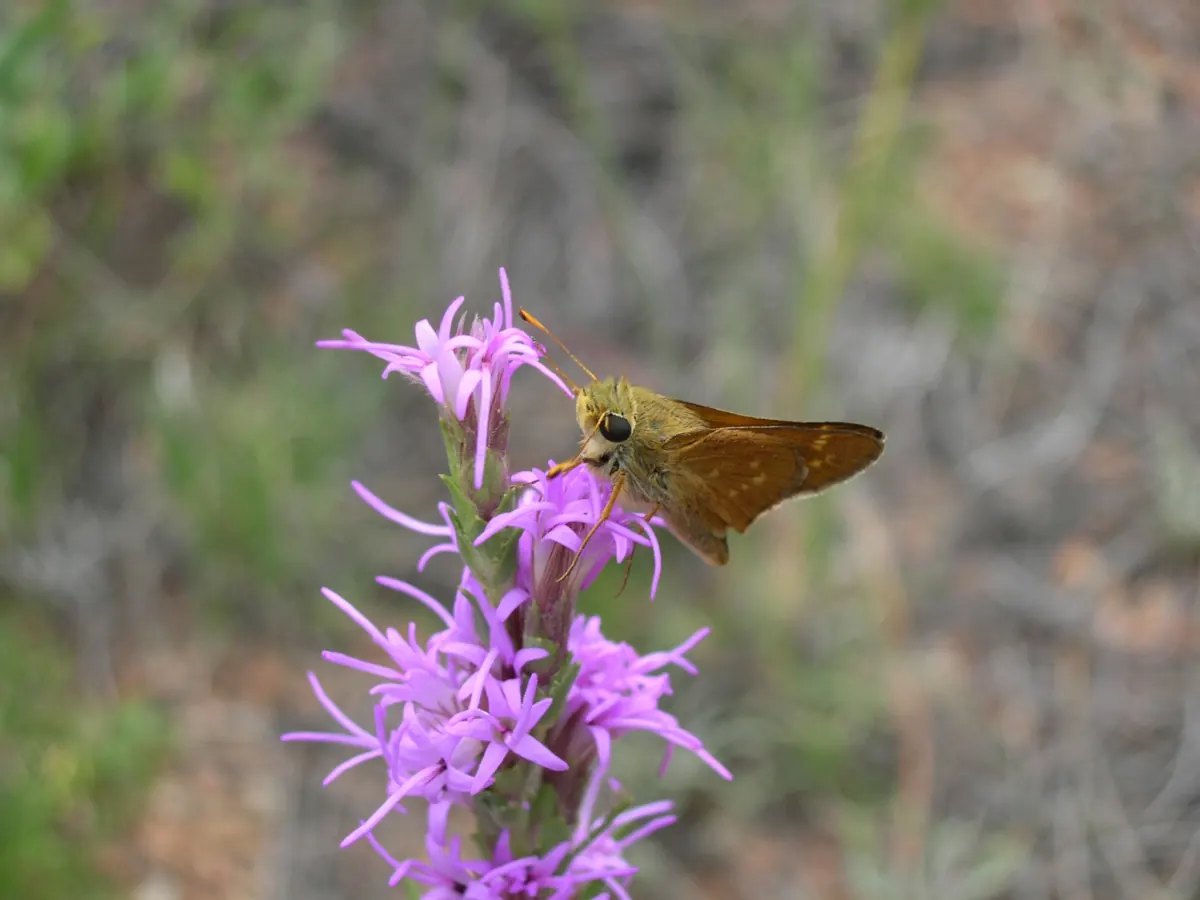
Adults are approximately 2.5–3 centimeters in wingspan. The upper wing surfaces are orange-brown with darker brown borders; the underside of the hindwing shows the mottled brown and cream pattern characteristic of Hesperia skippers. Males perch on prominent vegetation and hillsides to encounter females. Adults nectar mainly on prairie gayfeather (Liatris punctata), along with asters, bee balm, and other late-summer flowers.
Larvae feed exclusively on blue grama grass (Bouteloua gracilis), spending most of their lives in the litter layer at the base of grass clumps. This tight larval host specificity means the species cannot persist without adequate blue grama — and blue grama requires the open, sunny ponderosa pine forest conditions that fire historically maintained and that fire suppression has allowed to close.
The short adult flight window creates a narrow target for both observation and reproduction. The species is highly sensitive to weather during the flight period; a cool, wet August can substantially reduce adult activity and reproductive success.
Habitat in Colorado
The range centers on Deckers and extends northwest toward Pine, in three subpopulations: the mainstem South Platte, the Cheesman Reservoir area, and the North Fork. This is the entirety of this butterfly’s world range. The habitat is open ponderosa pine woodland on south-facing slopes and canyon walls with patches of blue grama grass in the understory and abundant late-summer flowers for nectar.
“Open” is the critical qualifier. The ponderosa pine forest that supports the Pawnee montane skipper must be open enough for sunlight to reach the forest floor, where blue grama grass grows and where larval development occurs. Fire suppression has allowed shrub encroachment and tree densification in many ponderosa pine forests throughout the West, including in the South Platte canyon, closing the understory and eliminating the blue grama patches that the skipper requires.
No critical habitat has been designated for the species; about 70% of its habitat lies on the Pike-San Isabel National Forests.
Threats
Wildfire
The 2002 Hayman Fire burned about 36% of the skipper’s habitat (8,978 acres), much of it at moderate to high severity, and recent counts remain below 1980s densities. Proposed dams and reservoirs on the South Platte and climate change are also listed threats.
Fire suppression, which lets pine forests grow too dense, is a long-standing habitat threat. Open ponderosa pine woodland with a diverse forb and grass understory — the natural condition maintained by low-to-moderate intensity fire — has been replaced in parts of the range by denser stands with shrub-dominated understories where blue grama cannot persist.
Recreation disturbance may affect local habitat in a canyon corridor that receives heavy use from Denver-area hikers, mountain bikers, anglers, and off-highway vehicle users. Trampling of larval habitat and disturbance of adult feeding and mating behavior during the narrow flight window can reduce reproductive success.
Invasive plants — particularly species that displace native grasses and forbs in the understory — reduce the quality and extent of blue grama patches available for larval development.
Drought reduces plant productivity and can reduce adult emergence numbers in years of severe moisture stress during the larval development period.
Recovery & Conservation
The Pawnee montane skipper was listed as threatened on September 25, 1987. Recovery actions focus on maintaining and restoring open ponderosa pine woodland conditions through prescribed fire, mechanical thinning, and invasive plant management across the skipper’s range.
The Pike-San Isabel National Forests, which hold about 70% of the skipper’s habitat, factor the species into thinning and prescribed-fire planning. The U.S. Forest Service monitors skippers and their habitat, and a multi-agency team including USFWS and Denver Water studied the burned areas after 2002.
What You Can Do
- Visit the South Platte canyon in late August to observe adults — this is one of the few chances to see this endemic butterfly in its flight window. Bring a field guide; distinguishing it from other Hesperia requires attention to detail.
- Stay on designated trails in the canyon during July through September to avoid trampling larval habitat in blue grama patches beneath ponderosa pines.
- Report flight activity to iNaturalist during late summer. Dated records of adult abundance contribute to population trend monitoring.
- Support prescribed fire programs in the Pike-San Isabel National Forests. The ponderosa pine woodland that the Pawnee montane skipper requires is managed by fire, and without it, habitat quality declines.