Overview
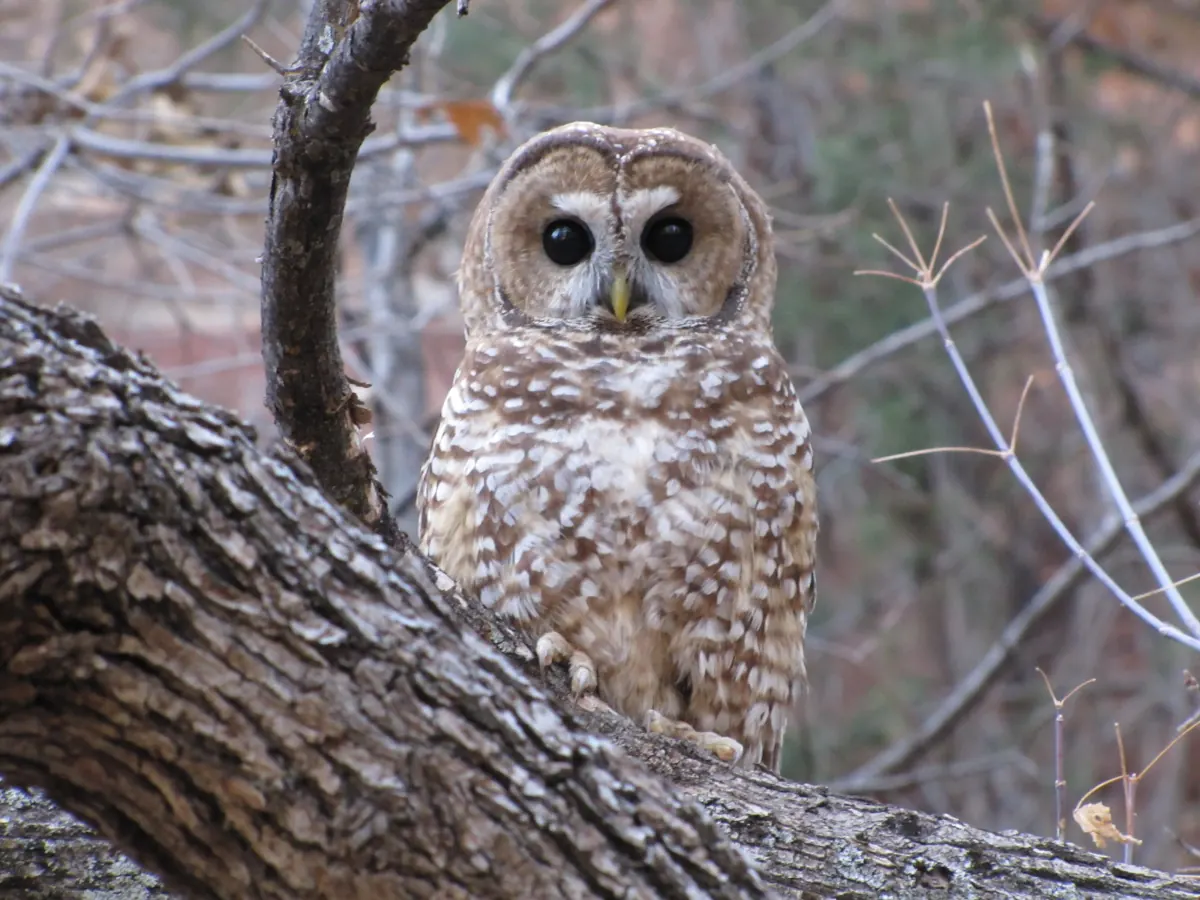
The Mexican spotted owl is a large, dark owl with rich brown plumage patterned in white spots and dark eyes uninterrupted by ear tufts — a field mark that separates it from the great horned owl at a glance. It inhabits the deep-shadowed canyons and old-growth forest of the American Southwest in a way that makes it seem like a product of the landscape: dim, complex, ancient.
Colorado holds a small, poorly known population of this federally and state threatened subspecies, in rocky canyons of the Front Range and Wet Mountains and in the Colorado Plateau canyon country of the southwest. Mesa Verde National Park, with its canyon landscapes and mixed conifer forest, supports documented owl territories. Additional canyon habitat occurs elsewhere in southwestern Colorado.
The Mexican spotted owl was listed as federally threatened in March 1993. The listing reflected the species’ dependence on old-growth and structurally complex forests — forest types that had been dramatically reduced through logging, and whose natural fire-maintenance dynamics had been altered by a century of fire suppression. Those pressures have not abated, and high-severity wildfire — intensified by climate change and the accumulated fuel loads of fire suppression — has emerged as an increasingly significant threat to the complex forest conditions the species requires.
Natural History
The Mexican spotted owl (Strix occidentalis lucida) is the southernmost of the three subspecies of spotted owl, which also include the northern spotted owl of the Pacific Northwest and the California spotted owl. Adults are 43–48 centimeters in length with a wingspan of approximately 110 centimeters. The dark, chocolate-brown plumage with white and buff spotting provides effective camouflage against bark and lichen in the forest interior.
Unlike most owls, the spotted owl has dark rather than yellow or orange eyes, giving it a distinctly different expression from the owls most people are familiar with. The round facial disk focuses sound toward the ears for precise auditory hunting in dark forest conditions.
Diet is dominated by woodrats (particularly Mexican woodrat in the Southwest), deer mice, voles, and other small mammals, supplemented by birds and large invertebrates. The owl is a generalist predator within its range of prey sizes, adapted to the forest small mammal communities of the Southwest.
Spotted owls are strongly territorial and long-lived — banded individuals have been documented up to 15 years in the wild. Pairs typically nest in the same territory for multiple years, using stick nests, cliff ledges, cavities in large trees, or the tops of large broken snags. The species is highly sensitive to disturbance during the breeding season, March 1 through August 31; nest abandonment following human approach is documented.
Habitat in Colorado
The Mexican spotted owl in Colorado is associated with two primary habitat types: rocky canyons of the Colorado Plateau in the southwest, and steep montane canyons of the Front Range and Wet Mountains.
In the canyon lands of the Colorado Plateau — including Mesa Verde — the species uses steep-walled canyons with mixed conifer forest on the slopes and cliff faces and talus for nesting and roosting. The broken topography of canyon country provides the structural complexity the owl requires and the natural protection from fire that flat forest terrain does not offer.
In montane forest, the species uses old-growth and structurally complex mixed conifer and ponderosa pine forest with large trees, multilayered canopy, substantial down wood, and abundant large snags. This is forest that has had time to develop the structural complexity that logging removes and that fire suppression, paradoxically, both maintained (by excluding stand-replacement fire) and compromised (by allowing fuel accumulation that now drives high-severity fire).
Federal agencies use a USFWS survey protocol in potential habitat when projects require Endangered Species Act consultation, and management centers on 600-acre Protected Activity Centers around known owl sites.
Threats
High-severity wildfire is an increasing existential threat. The owl requires structurally complex old-growth forest, and large, high-severity fires that kill the canopy and reset the forest to an early successional state eliminate decades of habitat development in a single event. Climate change is driving larger, hotter fires in Colorado’s canyon and montane forests.
Logging and timber harvest removes the large trees, snags, and structural complexity that old-growth forest provides. Even selective harvest in forests with owl territories removes elements the species requires and cannot quickly recover.
Altered fire regimes from a century of fire suppression have accumulated fuel loads that make the fires that do occur far more severe than the low-to-moderate-intensity fire that historically maintained open, structurally complex forest conditions in ponderosa and mixed conifer types.
Barred owl (Strix varia) competition is an emerging concern. The barred owl’s range expansion westward from the eastern United States is affecting northern spotted owl populations severely; whether barred owls are moving into Mexican spotted owl range is not yet known.
Recreational disturbance during the nesting season, particularly in popular canyon recreation areas, can interrupt breeding.
Recovery & Conservation
USFWS listed the Mexican spotted owl as threatened on March 16, 1993. The recovery plan outlines habitat conservation goals, monitoring protocols, and management recommendations for forests and canyon lands across the range. The recovery plan was first revised in 2012, and a 2023 USFWS five-year review recommended keeping the owl listed as threatened. In 2004 USFWS designated about 8.6 million acres of critical habitat, including about 322,000 acres in Colorado’s Pikes Peak, Devil’s Head, and Wet Mountains areas.
The survey protocol and Protected Activity Centers provide site-level protection that is meaningfully effective when implemented and enforced.
Recovery in the face of increasing wildfire and climate change will require both protective regulations and active management — strategic thinning and prescribed fire in forests adjacent to owl territories to reduce the risk of catastrophic fire without removing the old-growth structure the owls require.
What You Can Do
- Give known nesting areas a wide berth from March through August. Disturbance during nesting can cause a pair to lose a breeding season.
- Report sightings to eBird and CPW. Records of spotted owls in Colorado, including locations and behavioral observations, are valuable monitoring data.
- Support responsible forest management in Colorado’s canyon and montane forests — management that reduces catastrophic fire risk while retaining old-growth structure and large trees.
- Stay on designated trails in canyon recreation areas such as Mesa Verde during the breeding season to minimize disturbance in occupied habitat.