Quick facts
- Wolves in Colorado
- 45 as of Sept. 24, 2026, including 20 pups (CPW)
- Packs
- Four reproducing packs, plus a fifth pack of traveling siblings
- Released
- 25 (10 from Oregon in 2023, 15 from British Columbia in 2025)
- Federal status
- Threatened; 10(j) nonessential experimental population
- State status
- Endangered
- Report poaching
- Operation Game Thief, 1-877-265-6648
Population rapidly evolving. Colorado’s wolf reintroduction is an active, ongoing wildlife management program with frequently changing pack counts, territory establishment, and livestock conflict incidents. This profile reflects information available as of the last review date. Check Colorado Parks and Wildlife for current pack counts, territory maps, and livestock depredation data. Review this profile quarterly.
Overview
The gray wolf returned to Colorado in December 2023. CPW released ten wolves from Oregon between December 18 and 22, 2023, in Grand and Summit counties. It was the culmination of a years-long process that started with a narrow public vote and required navigating the most politically contested terrain in American conservation: the question of whether large predators belong in a human-modified landscape.
Colorado voters approved Proposition 114 in November 2020 by a margin of 50.9 percent to 49.1 percent — one of the closest wildlife votes in state history, and among the first times voters in any state have directly approved a large carnivore reintroduction. The measure directed CPW to restore and manage gray wolves by the end of 2023. CPW fulfilled that mandate.
Wolves were eliminated from Colorado by the 1940s through hunting, trapping, and poisoning. The animal returned only after roughly eight decades of absence from a landscape that had been shaped, in part, by its presence — prey populations unchecked by apex predation, ecological cascades running without a key participant.
The reintroduction is not finished. It is barely started. In 2024, one pack — the Copper Creek pack — produced Colorado’s first wild-born pups in about eight decades. As of September 24, 2026, CPW was aware of 45 wolves in Colorado, including 20 pups born in 2026, up from 32 last spring. It counts four reproducing packs, a fifth pack of siblings traveling together, and several wolves not currently in packs, and it expects the number to fall by March 2027 because of typical pup survival. That is a beginning, not a recovery. What happens over the next decade — whether the Colorado population grows and stabilizes, whether livestock conflicts remain manageable, whether illegal killing remains rare — will determine whether Colorado’s wolves survive to establish the kind of self-sustaining population that the state’s vote called for.
Natural History
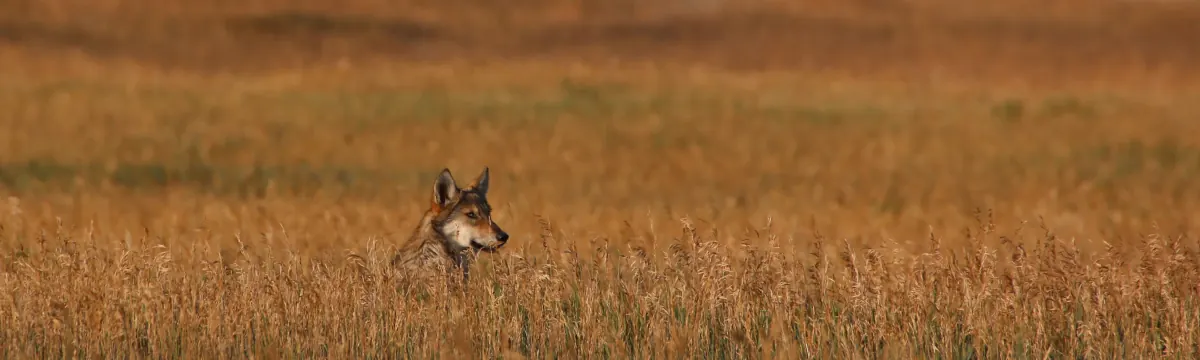
The gray wolf (Canis lupus) is the largest wild member of the dog family, with adult males in the Rocky Mountain population typically weighing 90 to 110 pounds (CPW), roughly 41 to 50 kilograms, and measuring 1.4 to 1.7 meters from nose to tail tip. Coat color ranges from white through gray and brown to black; the “gray” in gray wolf is an average, not a constraint.
Wolves are social hunters that live and hunt in packs — typically a breeding pair (the “alpha” pair) and their offspring from multiple years, with pack size typically ranging from 5 to 15 individuals in Rocky Mountain populations. Pack territories are large — 100 to 500 square kilometers — and are defended against other wolf packs through scent marking, howling, and direct confrontation. Pack-level hunting allows wolves to take prey much larger than an individual could handle: elk, deer, and in some systems bison.
The breeding pair typically produces a single litter of four to six pups in spring. Pups are born in dens and raised cooperatively by the pack; older offspring from previous years participate in pup care and feeding. Wolves reach sexual maturity at two years, and dispersing individuals from established packs are the mechanism by which new territories and packs form.
Elk are the likely primary prey for Colorado’s wolves, with mule deer as secondary prey. The wolves from Oregon and British Columbia that founded the Colorado population came from ecosystems with well-established predator-prey dynamics involving these species.
Habitat in Colorado
The initial release sites in Grand and Summit counties, and the January 2025 release sites in Eagle and Pitkin counties, placed wolves in high-quality montane forest and subalpine habitat on the western slope, with access to the large prey base — primarily elk — that the high-country elk herds provide. The surrounding landscape of national forest and adjacent public and private land provides the open space and low road density that wolves require.
Wolf territories in Colorado will likely expand over time as the population grows and dispersers establish new packs. The western slope is the primary expected recovery area, though dispersers can and do move across the Continental Divide; wolves from the established Greater Yellowstone and Northern Rocky Mountain populations have historically appeared in Colorado before the formal reintroduction.
No critical habitat has been designated in Colorado under the federal listing.
Threats
Illegal killing is the most acute threat to a newly establishing population. The Colorado population is small enough that the loss of a few individuals to poaching could significantly set back recovery. State and federal penalties for illegal wolf killing are substantial; enforcement depends on public reporting of suspicious mortality.
Livestock conflict is the predictable source of the most intense social tension around wolf reintroduction. Wolves will prey on livestock; the question is how frequently, how distributed across ranchers, and whether compensation programs and non-lethal deterrence can keep conflict at levels that maintain ranching community tolerance. CPW has established a livestock depredation compensation program and a conflict response team as part of the reintroduction framework. In 2024 CPW captured the Copper Creek pack after repeated livestock losses; its breeding male, found injured, later died, and USFWS says he had been illegally shot. CPW’s 2025–26 annual report recorded 10 adult wolf deaths and an adult survival rate of about 61 percent.
Since April 2026, CPW says it has lethally removed five wolves to address chronic depredation, and it is investigating one more death. On September 30, 2026, CPW paused its chronic depredation directive after reviewing translocation efforts, survival rates and other biological factors; any revisions would take effect April 1, 2027. That 61 percent adult survival compares with about 75 percent in typical unharvested populations; pup survival was 82 percent. CPW is investigating hair loss in two northwest Colorado packs that could be related to an infectious skin parasite, and it said population growth “may not occur this biological year.”
Small population vulnerability — at current numbers, stochastic events (disease outbreak, severe weather, poaching cluster) could significantly affect the trajectory of recovery. Building a population large enough to absorb normal losses requires sustained growth over multiple years.
Recovery & Conservation
Colorado’s reintroduction is governed by a Colorado Wolf Restoration and Management Plan developed by CPW with extensive stakeholder input over several years. The plan establishes objectives for population size, pack distribution, livestock conflict management, and delisting criteria.
The wolves released in December 2023 were sourced from Oregon under a cooperative agreement between CPW and the Oregon Department of Fish and Wildlife. CPW released 15 more wolves from British Columbia in January 2025, in Eagle and Pitkin counties. No wolves were released in the winter of 2025–26.
Colorado’s wolves are classified as a 10(j) nonessential experimental population under the ESA and are treated as threatened, which provides management flexibility while maintaining federal protection against illegal take. The species remains endangered elsewhere in most of the lower 48. In December 2025 the U.S. House passed a bill to remove federal protection from gray wolves in the lower 48; as of September 2026 the Senate has not acted.
Pack formation and the first pup production in 2024 represents the reintroduction achieving its first meaningful milestone. The real measure of success will be self-sustaining population growth over the next five to ten years.
What You Can Do
- Report wolf sightings or suspected wolf activity. Report wolf sightings through CPW’s online wolf sighting form. Report poaching to Operation Game Thief at 1-877-265-6648, or to USFWS at 1-844-FWS-TIPS. Photographs and locations of wolves, tracks, or wolf-killed livestock are all valuable. Do not approach wolves.
- If you’re a livestock producer in the western Colorado reintroduction area, contact CPW about non-lethal deterrence assistance — range riders, guardian dogs, and livestock protection measures — and the depredation compensation program if livestock are killed by wolves.
- Check CPW’s wolf management page for current pack counts, territory maps, and updates — this is the most rapidly evolving wildlife story in Colorado and the profile here will lag behind real-time developments.
- Report suspected illegal wolf killing to Operation Game Thief or USFWS immediately, using the numbers above. At current population sizes, every individual wolf matters.
Frequently asked questions
- How many wolves are in Colorado?
- 45, as of September 24, 2026, according to Colorado Parks and Wildlife, including 20 pups born in 2026. CPW counts four reproducing packs, a fifth pack of siblings traveling together and several wolves not currently in packs. It expects the number to fall by March 2027 because of typical pup survival.
- Where are wolves in Colorado?
- On Colorado's western slope. CPW released wolves in Grand and Summit counties in December 2023 and in Eagle and Pitkin counties in January 2025, and it confirmed the Piney Ridge Pack in Eagle County in July 2026.
- Can you shoot a wolf in Colorado?
- Generally, no. The gray wolf in Colorado is protected by the federal Endangered Species Act and state law; landowners must apply to CPW to take wolves, even ones caught in the act of attacking livestock, and CPW must confirm a depredation before it issues a lethal take permit. State law allows people to protect human safety when there is an immediate threat, and unlawful killing can bring substantial fines, jail time and loss of hunting privileges.
- Are wolves endangered in Colorado?
- Yes, under state law. Federally, Colorado's wolves are a 10(j) nonessential experimental population treated as threatened, under a rule that took effect December 8, 2023. The U.S. House passed a bill to remove federal protection in December 2025, but as of September 2026 the Senate had not acted.
- Is Colorado killing wolves?
- Yes. Since April 2026, CPW says it has lethally removed five wolves to address chronic depredation and is investigating one more death. On September 30, 2026, CPW paused its chronic depredation directive; any revisions would take effect April 1, 2027.